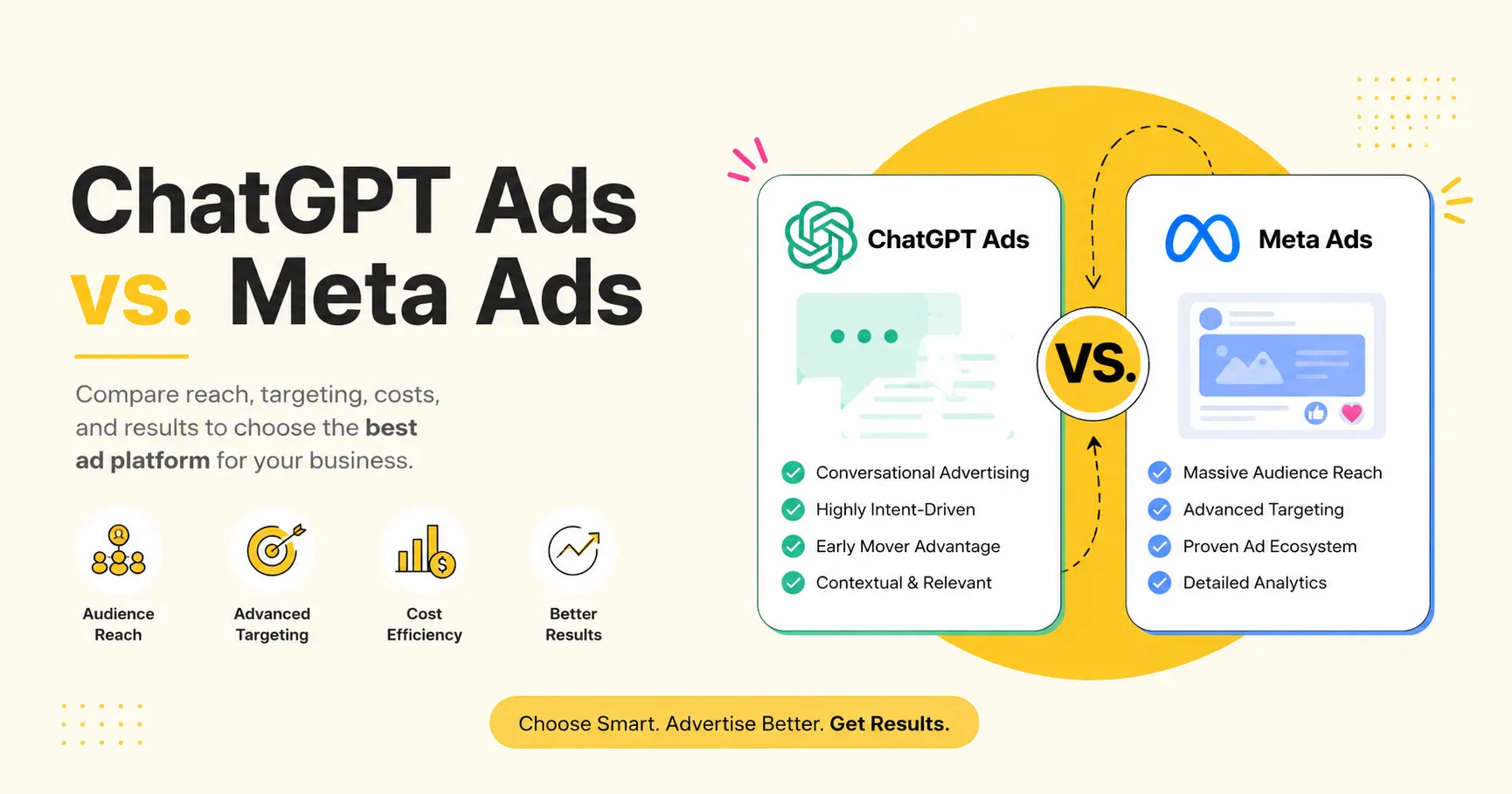
The world of advertising is experiencing the most radical change in 20 years. ChatGPT Ads vs Meta Ads is a battle that is no longer in the future, but one that is currently happening. With every business trying to spend their budgets in a smart way, the question of the hour in boardrooms is whether to bet on conversational AI advertising or go with the social media machine that has served businesses well and remains a proven concept, Meta.
ChatGPT Ads vs Meta Ads are two very different philosophies of targeting customers when we discuss them. The leading paid social platform, Meta Ads (including Facebook, Instagram, Messenger, and Audience Network), is over ten years old. The advertising platform at ChatGPT, which is in early rollout, could be the next step in the history of AI-based advertising platforms, as it targets users at the point of active search and actual curiosity.
This is a complete guide that dissects all the stuff you will need to know: the price, the target audience, the performance levels, the applications of it, and which platform should be allocated your budget in 2026.
What Are ChatGPT Ads? Understanding the ChatGPT Advertising Platform
It is crucial to learn what ChatGPT advertising is before delving deeper into the ChatGPT Ads vs Meta Ads comparison. In early 2026, OpenAI started testing sponsored placements within ChatGPT, initially to logged-in U.S. users. These advertisements are written as specific recommendation cards at the foot of the answers generated by AI.
ChatGPT Ads Features
ChatGPT Ads capabilities are unheard of in the advertising industry:
- Intent-based, contextual placement – advertisements are shown depending on what the users are actively searching.
- Recommendation card format: non-intrusive, text-based, proof-based creative.
- Conversational targeting – advertisements are relevant to the conversation, not only the keywords.
- User control – users are able to dismiss advertisements and leave feedback.
- Premium CPM rates – quoted at about 60 per 1,000 impressions.
The ChatGPT advertising platform radically transforms the advertising paradigm of interruption to assistance. Rather than interrupting the social scrolling of a user, the ad will show up when the user is already searching, meaning conversational ads and display ads are a key difference to consider in 2026 marketing.
ChatGPT Ads works best in high-consideration sectors: B2B software, financial services, and healthcare tools, e-commerce comparisons, travel planning, and education. In case your customer shops after researching, the advertising service of ChatGPT places you in a situation where your customer needs to buy something.
Meta Ads in 2026: Still the King of Social Advertising?
The other side of the ChatGPT Ads vs Meta Ads debate is a giant. The advertisement ecosystem of Meta covers more than 3.2 billion monthly active users on Facebook, Instagram, Messenger, and Audience Network. Advertising revenue on Meta was more than 48 billion in Q4 2025, and it is a testament to the scale that the platform enjoys.
Meta Ads Targeting Options
The gold standard in terms of audience accuracy in social advertising is still meta ads targeting:
- Demographic targeting – age, sex, place, language, education.
- Interest and behaviour targeting – purchase behaviours, life events, hobbies.
- Custom audiences- retargeting website visitors, email lists, and app users.
- Lookalike audiences – to new users who resemble your best customers.
- Advantage+ audience – AI-powered target optimisation by Meta.
The capabilities of the Meta Ads audience segmentation are the product of 20+ years of social data collection. This richness is the strength of Meta and the focus of continuous regulatory attention. When AI ad targeting is compared to Meta targeting, the latter is more successful in terms of the depth of the audience data, whereas ChatGPT is more successful in terms of the quality of intent.
Meta Ads Campaign Strategy
An effective Meta Ads campaign plan in 2026 capitalises on the entire funnel: widespread awareness (Reels and Stories), consideration in the mid-funnel (carousel and collection ads), and conversion (through retargeting custom audiences using dynamic product ads). The tips of Meta Ads optimisation are always based on a single fact: within a period of time, make sure that the Meta algorithm has lived long enough to leave the learning stage (usually 50 conversions per ad set) before making major changes.
ChatGPT Ads vs Meta Ads: Side-by-Side Feature Comparison
The ChatGPT Ads vs Meta Ads comparison can be best understood in terms of each feature per feature. At a glance, an overview of the data is provided in this table in order to make a quick decision.
| Feature | ChatGPT Ads | Meta Ads |
| Ad Format | Text recommendation cards | Image, video, carousel, Reels, Stories |
| Avg. CPM | ~$60 (premium) | $5–$15 (auction-based) |
| Avg. CPC | Not publicly disclosed | $0.50–$2.00 |
| Targeting Type | Conversational context | Demographics, behaviors, interests, lookalikes |
| Monthly Reach | ~180M+ active users | 3.2B+ monthly users |
| Measurement | Limited (early phase) | Advanced Pixel, CAPI, attribution |
| Creative Needs | Proof-led copy | Visual-first, mobile-optimized |
| Best Funnel Stage | Mid to lower funnel | Full funnel |
| Retargeting | Not yet available | Robust custom audiences |
| Best For | High-consideration B2B/B2C | Brand awareness, e-commerce, D2C |
ChatGPT Ads Pricing vs Meta Ads Cost Per Click
The ChatGPT Ads vs Meta Ads choice can usually be based on cost. The economics of every platform can be useful in predicting ROI and spending money wisely.
ChatGPT Ads Pricing
ChatGPT Ads is presently based on a premium CPM system. Preliminary reports show a CPM of about 60 per 1,000 impressions – 4 to 12 times costlier than Meta Ads on an unfiltered impression basis. Yet, raw impression cost is a bogus measure in cases where intent quality varies so radically.
It is not the number of dollars per impression that is important, but the number of dollars per qualified lead. Early B2B SaaS adopters state that ChatGPT Ads have much higher click-through rates because of intent-matching – i.e., the greater CPM can imply a reduced cost per acquisition.
Metacost Per Click
Depending on the industry, size of the audience, and the bidding strategy, Meta Ads have an average cost per click of between 0.50 and 2.00. CPC can be as low as $0.30 with e-commerce brands that target large audiences and as high as $3-5 per click with B2B technology companies that target decision-makers in the U.S. The data on the Meta Ads performance comparisons indicate that CPMs are usually between $5-15 across most verticals.
ChatGPT vs Facebook Ads ROI
The analysis of ChatGPT vs Facebook Ads ROI is subtle. Meta Ads provide established, quantifiable ROI with well-developed attribution technology – the Facebook Pixel, Conversions API and powerful A/B testing technology provide you with a clear picture of what is working. ChatGPT Ads are still in early stages of testing, and therefore, this has not yet been measured. But in the case of brands within verticals that are research-intensive, the potential ROI is great. The success of ChatGPT Ads increases exponentially with great testimonials, case studies, and data-supported copy.
Meta Ads vs AI Ads: Performance Deep Dive
The Meta Ads vs AI ads performance comparison involves more than just displaying CPM and CPC. The real performance encompasses engagement quality, conversion rates, customer lifetime value and brand lift.
ChatGPT Ads are winning in these areas
- Better intent of the user – the user is either in a research or decision-making mode.
- Reduce ad fatigue -recommendation cards are less obtrusive compared to social interruptions.
- Contextual precision — ads are shown in cases when they are closely related to the query of the user.
- Trust setting ChatGPT has a positive reputation to pass on to advertisements.
Where Meta Ads Win
- Unparalleled size – 3.2 billion users compared to ChatGPT with approximately 180 million active users.
- Video, carousel, and interactive forms of visual storytelling prompt brand recall.
- Retargeting sophistication, pixel-based, CAPI and engagement retargeting.
- Proven attribution – ROI is clearly measured and has 20+ years of ad data.
- Reduced entry barrier – begin with $5/day and increase according to performance statistics.
When comparing AI marketing tools, it is worth mentioning that both platforms are becoming progressively driven by machine learning – albeit differently. Advantage+ is a new tool created by Meta based on AI and optimisation of audience targeting and placements. The platform of ChatGPT is based on the use of AI at the very basis of the delivery of ads, which are matched to the context of conversation in real-time.
AI Ad Targeting vs Meta Targeting: The Basic Difference
Perhaps no aspect of the ChatGPT Ads vs Meta Ads debate is more important than targeting philosophy. These platforms do not simply work with alternative data; they have entirely different user-intent models.
The issue between AI ad targeting and Meta targeting is as follows: Meta knows who you are; ChatGPT knows what you are thinking at the moment. Meta is based on the past behavioural information of your history of purchases, pages that you liked, location history, and demographic data to predict your interests. ChatGPT builds on real-time conversation context – your query, at this particular time.
An example of a question that ChatGPT can be asked by a user is as follows: Which is the most suitable project management software to support a remote team of 20 people? An advertisement of a project management tool within such a response is not an interruption — it is a really helpful idea. This is what the ChatGPT advertisement platform promises and the essence of why it is such a drastic change in the advertising industry.
The Meta Ads audience segmentation method is incredibly powerful in terms of widespread recognition and interest-based campaigns. However, it will never have confidence in what a user is thinking at a particular time. This is why it is not really a competition between ChatGPT Ads and Meta Ads, but a complementary tool to each other that addresses various issues on different levels of the customer journey.
ChatGPT Ads vs Instagram Ads: A Comparison
Although the ChatGPT Ads vs Meta Ads comparison is based on the entire Meta ecosystem, the most commonly asked question by many marketers is how ChatGPT would compare to Instagram, which is the most visually stimulating and rapidly growing platform owned by Meta.
The biggest difference in creative format is ChatGPT Ads vs Instagram Ads. Instagram is a visual-based platform that is fueled by beautiful images, short video content, and content that is aesthetically curated. Millions of organic and paid views can be created via reels of the correct brand. ChatGPT, in its turn, is purely text-based. Images, videos, and visual brand identity are absent.
The visual canvas of Instagram is unreplaceable when it comes to consumer brands such as fashion, beauty, food, travel, and lifestyle. In case of B2Bs, SaaS solutions, financial services, or anything that requires the buyer to find out some information and then buy, the recommendation format of ChatGPT provides a viable alternative.
ChatGPT Ads Advantages and Benefits as Compared to Meta Ads

The benefits of ChatGPT Ads to business far outweigh the apparent intent-targeting benefit. The following are the strongest arguments as to why progressive advertisers are experimenting with the ChatGPT advertisement platform:
1. First-Mover Advantage: The initial use of the ChatGPT advertising platform may imply the reduction of competition, a more advantageous position, and a chance to develop expertise before CPMs increase.
2. Brand Safety: The controlled nature of ChatGPT will remove the brand safety issues that can be seen on social sites – there is no threat of being next to viral content.
3. High-Quality Audience: The audience of ChatGPT is more educated and highly earning professionals, which is an attractive audience in terms of buying B2B and luxury consumer goods.
4. Less Ad Fatigue: As opposed to the feed of Meta, where people have now become banner blind, the card of recommendations in ChatGPT is truly new to the majority of users.
To appreciate the benefits of ChatGPT Ads over Meta Ads, it is necessary to agree that the benefits are contextual. In the case of a D2C brand that is selling impulse-buy products, the visual ads will nearly always do better with Meta. In the case of an enterprise SaaS company selling a $50,000 yearly contract, the intent-driven environment of ChatGPT can provide significantly better qualified leads.
9. ChatGPT vs. Meta Ads Analytics Tools Measurement
The issue of analytics and measurement maturity is one point where ChatGPT Ads and Meta Ads comparison is one-sided.
Meta Ads analytics tools are considered to be one of the most advanced in digital advertising. The Ads Manager of Meta offers detailed segmentation by place, audience, creative and purpose. Facebook Pixel is incredibly precise in tracking on-site behaviour. The Conversions API (CAPI) is an API that fills the privacy gaps introduced by iOS, event tracking on the server side. The attribution windows can be personalised as a 1-day click or a 28-day view.
ChatGPT Ads are still in their early testing phase and, therefore, do not have many measurement options at the moment. Conversion tracking, attribution modelling, and audience insight tools are still in development, with the impression data and click-through rates being available. This is the greatest impediment to full adoption at present for performance marketers used to the richness of data at Meta.
With that said, marketing generative AI is developing at a pace. The advertising platform is likely to grow, and OpenAI will see tremendous growth in measurement functions. The future of AI advertising will certainly be the advanced attribution technology, which monitors the conversion path between the advertisement and the purchase.
ChatGPT Ads for Businesses: Who Should Use Which Platform?
The most viable conclusion of the ChatGPT Ads vs Meta Ads case is a concise guideline on which platform is applicable to what type of business. Business ChatGPT Ads are most effective in cases where your customers do a lot of research before buying.
| Business Type / Scenario | Recommended Platform |
| B2B SaaS — complex sale, long decision cycle | ChatGPT Ads (primary) + Meta (retargeting) |
| D2C e-commerce — impulse and lifestyle products | Meta Ads (primary) |
| Financial services — banking, insurance, investment | ChatGPT Ads + Google + Meta |
| Healthcare & wellness tools | ChatGPT Ads (intent-driven) |
| Fashion and beauty brands | Meta Ads / Instagram Ads |
| Education & online courses | ChatGPT Ads + Meta |
| Local brick-and-mortar business | Meta Ads (location targeting) |
| Enterprise software / high-ticket consulting | ChatGPT Ads (first mover advantage) |
Content creators running ad campaigns can also explore the best content monetization platforms to add more revenue streams alongside their paid advertising efforts.
Building a Winning ChatGPT Ads vs Meta Ads Strategy in 2026
The most advanced marketers do not make it an either/or decision between ChatGPT Ads and Meta Ads. They instead make combined plans where each platform is used to its strengths throughout the customer journey.
The Integrated Approach
- Top of Funnel: Use the broad targeting and visual formats of Meta Ads (Reels, Stories) to create brand awareness at scale. The impression volume is affordable due to the low CPM.
- Mid Funnel: Roll out ChatGPT Ads to reach those who are researching your category. These users are screening alternatives – your recommendation puts you in the role of the expert solution.
- Bottom of Funnel: You can use the retargeting features of Meta to retarget website visitors and add to cart abandoners. The loop is closed with dynamic product ads that have high social proof.
Optimisation tips to consider in 2026 are to test Advantage+ Shopping Campaigns with e-commerce, broad targeting and allowing AI to discover your best customers, and investing in creative testing, specifically short-form video to place in Reels. The success of the Meta Ads campaign strategy is gradually relying more on the creative quality than targeting precision, since the AI of Meta does much of the targeting itself.
Pairing your ad strategy with the best backlink analysis tools in 2026 for SEO success helps you build organic authority alongside paid campaigns for stronger overall digital growth.
Future of AI Advertising: What Is the Future of ChatGPT Ads vs Meta Ads?
The ChatGPT Ads vs Meta Ads controversy is an intro to a significantly bigger change. The future of AI advertising lies in the platforms that will not only target you based on who you are or what you searched, but will actually know what you are interested in, what is going on and what you need in real time.
Marketing Generative AI is already transforming creative production. With the AI tools, brands can now create hundreds of variations of ads in hours, test them programmatically, and have machine learning determine the winners. Meta and OpenAI are both spending a lot of money on AI-based creative features: Advantage+ Creative, an AI-based ad generation tool at Meta, and an AI-based ad copy generator at scale within the OpenAI ecosystem.
The lines between AI ads and social media ads will continue to blur. Meta is adding additional AI in its targeting and creative products. The capabilities being developed by OpenAI in their advertising platform are progressively becoming similar to those of traditional ad networks. The marketers that will emerge victorious will be those who become fluent in both ecosystems and develop a strategy that will utilise the strengths of one another.
The landscape of ChatGPT Ads vs Meta Ads in 2027 and beyond is expected to include sophisticated attribution models that will connect conversational ad exposures to downstream conversions, cross-platform audience matching between AI platforms and social networks, and a new category of AI-driven advertising platforms offered by Google, Microsoft and others in competition over the conversational advertising opportunity that OpenAI is currently embracing.
Conclusion: ChatGPT Ads vs Meta Ads — Making the Right Choice for Your Business
There is no real answer to the ChatGPT Ads vs Meta Ads question, and that is a good thing for marketers. It implies that both platforms will play an authentic role, and the brands that will emerge as victors will be those that comprehend the unique value proposition of both.
Use ChatGPT Ads when your customers do a lot of research before buying, intent alignment is more important than audience size, and you wish to be a first-mover in a new but promising advertising medium.
Use Meta Ads when visual storytelling is at the heart of your brand, when scalability is fundamental to your business, when retargeting and custom audiences are central to your strategy, and when you require measurement maturity that is non-negotiable.
Combine them when you are willing to have a full-funnel approach that leverages ChatGPT intent-based awareness in the middle of the funnel and Meta retargeting strength at the bottom of the funnel.
The ChatGPT Ads vs Meta Ads discussion is about knowing where your customer is at their stage and being there with the correct message and on the correct platform. Get that, and you will be out of 90 per cent of your competitors in the AI advertising phase that is just coming on.
Key Takeaways
- The differences between ChatGPT Ads and Meta Ads lie in the very nature of targeting philosophy: intent vs. interest.
- ChatGPT Ads is more expensive (~60 CPM) but provides a better match of intent.
- Meta Ads are not matched in price per click (0.50-2) and the quantity of users (3.2B).
- ChatGPT Ads capabilities are optimised to do well with high-consideration purchases of research-intensive items.
- Meta Ads analytics are much more developed than has been measured by ChatGPT.
- The future of AI advertising is in combined strategies, which take advantage of both platforms.
- There is a first-mover advantage on the ChatGPT advertisement platform at the moment – try it.