
When people need a GP, physiotherapist or specialist, their first port of call is almost always a Google search. If your clinic isn’t listed in those results, then it doesn’t exist — at least not to that patient. Healthcare SEO involves optimizing your website and online presence to ensure they rank highly in search results when patients are looking for the services you offer.
Done correctly, it’s the most affordable way to acquire patients for any medical practice. This guide has you covered – from healthcare keyword research to local search, technical foundations, and content – so your clinic can compete and win in search results.
What Does SEO Really Mean for Healthcare Services?
Healthcare SEO services involve optimizing a clinic’s website and online presence to improve its placement in search engine results pages (SERPs). Medical clinic SEO is not the same as general SEO. Medical SEO is a high-stakes business. The information on your site can directly impact someone’s health decision.
There are, however, several related disciplines that are involved in healthcare search engine optimization, such as on-page content, technical website performance, local search signals and authority building. A well-executed clinic website SEO campaign will ensure that when a patient searches for a service you offer in your local area, your clinic will be highly visible – ideally in the local map pack and on the first page of organic results.
Medical website optimization has a layer of trust and accuracy that makes it different. Clinics have to do well on the technical and editorial sides because Google has higher quality standards for health-related content than most industries.
Why You Can’t Ignore SEO in Your Medical Practice
Medical practice SEO is no longer a “nice-to-have” — it’s a core part of how patients find, evaluate and choose a provider. Look at how patient behaviour has evolved. Most people looking for a clinic, a doctor, or a health service start their journey online, often with a location-based search such as “physiotherapist near me” or “private GP in [city]”.
Healthcare digital marketing encompasses paid advertising, social, and email, but organic search provides something none of those channels can: high-intent traffic from people actively searching for what you have to offer. A patient searching for “sports injury clinic” isn’t browsing — they’re ready to book.
Without a strong SEO for doctors and clinic strategy, clinic online visibility suffers, and practices face:
- Near-invisibility in local search results
- Loss of new patients to better-optimised competitors
- Paid advertising with ongoing costs and no compound return
- Tarnished reputation in an increasingly review-driven market
Clinic SEO strategies that build organic visibility have compounding returns over time. A paid campaign stops when the budget is depleted, but a good organic ranking continues to drive traffic to your healthcare website month after month.
YMYL Explained: Why Google Holds Medical Websites to a Higher Standard
YMYL SEO for healthcare websites is one of the most important concepts that any clinic owner or marketer needs to know. YMYL — Your Money or Your Life — is Google’s internal term for content that could have a significant impact on a reader’s health, financial stability or safety.
Medical clinic websites are squarely in the YMYL space. Google holds your content to a much higher standard than a lifestyle blog or an e-commerce site. Google’s quality evaluation systems are likely to give less weight to, or actively suppress, thin content, unverified claims, or pages not written with clear medical oversight.
In practice, this means that every single page of your clinic’s website needs to be:
- Accurate and current with current medical guidance
- Medically reviewed by or written by our medical review team.
- Free of exaggerated claims or unverified health promises
- Clearly attributed to a named, credentialed author, where appropriate
Specifically for SEO for private clinics and independent practices, YMYL compliance is not a mere SEO checkbox but a baseline requirement to be trusted by Google and prospective patients.
E-E-A-T: How Google Decides Whether to Trust Your Clinic
E-E-A-T stands for Experience, Expertise, Authoritativeness, and Trustworthiness and is closely related to YMYL. These are the criteria that Google’s quality raters look at to determine if a healthcare website deserves to rank. E-E-A-T is the delineation of the medical practice online presence that Google considers trustworthy from those it doesn’t.
Here’s how each element translates to clinic websites:
- Experience: Does the content reflect real-world clinical experience? Real experience is indicated by patient case studies, procedure explanations provided by practitioners, and condition guides based on actual clinical practice.
- Expertise: Are your authors knowledgeable? Doctor profile optimisation matters here: every piece of health content should be attributed to a named clinician with visible credentials, GMC/NMC registration numbers (where applicable) and a linked professional bio.
- Authority: Are there other authoritative sources that mention or link to your clinic? Getting healthcare link building through medical directories, professional associations, and health industry publications builds up your authority tremendously.
- Trustworthiness: Is your website trustworthy? Google’s algorithms look for trust signals including the use of HTTPS, contact information, pricing transparency, and patient reviews.
E-E-A-T is how Google views your healthcare reputation management, and it all starts with your own website.
Why Healthcare SEO Is Harder Than It Appears
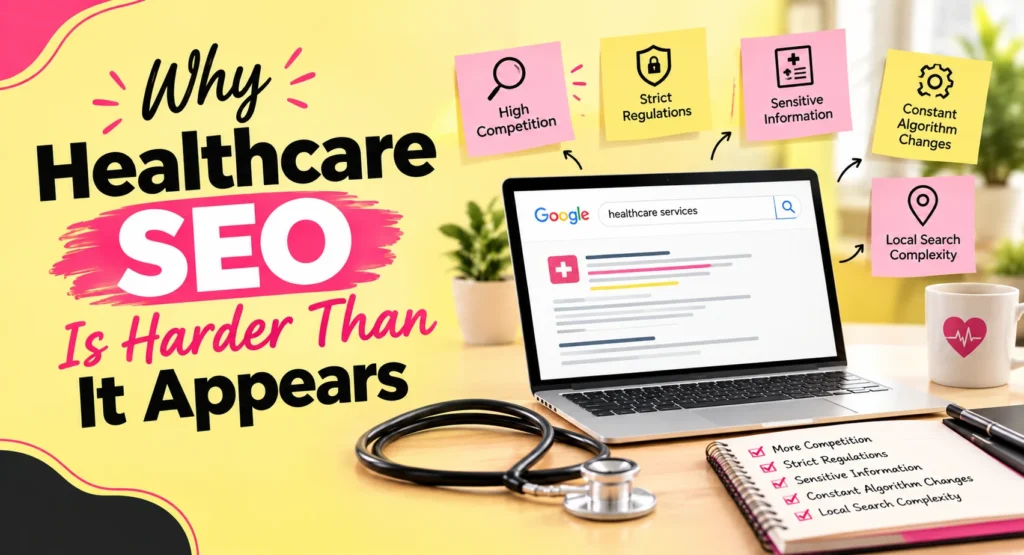
SEO in the healthcare sector differs from SEO in other sectors. Healthcare SEO faces a number of particular difficulties.
- Content must be accurate: Every single claim needs to be cited, backed up, and up to date. Content that was correct two years ago may now conflict with updated clinical guidance, creating both SEO and compliance risks.
- Regulatory restrictions: You may not make certain claims about the results or warranties. Advertising standards, CQC guidance (UK) and professional body rules all limit some of the persuasive language that works well in other industries and shape what you can and can’t say on a clinic website.
- High local competition: Local search optimisation is highly competitive for medical clinics in urban areas. Practices competing in the same postcode and same speciality mean rankings are hard-won and easily lost.
- Trust is built over time: Medical SEO services won’t give you results overnight. If you’re a new clinic website or a practice with a thin online history, you’re working with a trust deficit that can take six to twelve months of consistent effort to overcome.
- Content maintenance: Medical content optimization is an ongoing process. Clinical guidelines change, new treatments evolve, and stale pages can actively harm both rankings and patient trust.
Patient Searches: Developing a Keyword Approach That Accurately Reflects Patient Intent
Effective healthcare keyword research begins with understanding how patients actually search, which is often very different from the clinical terms practitioners use.
There are three main ways patients search:
- Symptom-based: “knee pain when walking,” “sharp chest pain left side,” “child with recurring ear infections” – these are early-stage searches where the patient hasn’t (yet) identified the type of clinic they need.
- Service-based: “physiotherapy for back pain”, “private dermatology consultation”, “sports injury assessment” – Mid-funnel searches where the patient is aware of the treatment category.
- Local intent search terms: “GP near me”, “private clinic [city]”, “dentist [postcode]” – high-intent searches. About to make a booking.
For local search, anchor medical keywords on your main service pages. Every important service your clinic offers should have its own website dedicated to ranking for that particular service.
Depth of content should match the stage of the query for healthcare search intent. Educational blog content works best for symptom-based queries. Service and local intent queries require conversion-focused service pages with clear Calls to Action, pricing signals, and booking options.
Medical blog SEO is a supporting role: Well-optimised condition and treatment articles capture top-of-funnel traffic and funnel readers toward service pages where they convert.
Tools to use: Google Search Console (to see what you already rank for), Google’s autocomplete, and People Also Ask boxes and dedicated keyword tools for volume and competition data.
How to Organize Your Schedule and Take Charge of Local Search
Local SEO is the #1 most-leverage opportunity in healthcare for most clinic owners. The majority of new patients are booked via local searches – and the clinics that dominate the local map pack get a disproportionate share of that traffic.
Why Your Google Business Profile Is Your Most Important Local Asset
Google Business Listing of Clinics is the key to local search success. If your profile is accurate, complete and actively managed, your chances of showing up in the local three-pack improve dramatically. Key steps for optimisation:
- Choose the most specific primary category (e.g. “Physiotherapy clinic” rather than just “Health”)
- Add all services with descriptions.
- Upload real photos of your premises, team and facilities
- Keep opening hours up to date — including holiday closures
- Answer frequently asked questions by patients in the Q&A section.
- Post regularly to show an active practice
- Getting your clinic’s name, address and phone right online
Clinic local search rankings are mainly driven by consistent NAP data – Name, Address, Phone number – across every online directory and listing. Confusions will make Google confused and affect your ranking negatively. Audit your NAP across medical directory listings like NHS Choices (UK), Healthgrades, Doctify and Google Business Profile.
Directories That Really Matter For Healthcare Clinics
Creating citations in relevant healthcare directories reinforces local search optimization for clinics. Priority listings include specialty-specific directories (Physio First, BACP, etc.), local business directories and condition-specific patient platforms.
The Impact of Patient Reviews on Your Local Rankings
Patient reviews and ratings are one of the biggest factors in local rankings. New, positive reviews help clinics rank higher than competitors in local pack rankings. Motivate your delighted patients to write Google reviews — and always respond to reviews in a professional manner, whether they are positive or negative. Reviews also build trust for active healthcare reputation management that turns browsers into booked patients.
How to Improve Clinic Ranking on Google Maps
There are three main factors that affect your clinic’s Google Maps ranking: 1. Proximity to the searcher 2. Relevance of your profile to the search term 3. Prominence (the strength of your overall online presence). You can’t control proximity, but relevance and prominence are entirely within your control through consistent optimisation.
The Technical Fixes That Stop Your Clinic Website From Holding Itself Back
Technical SEO for medical websites is the base that everything else sits on. Even the best content strategy won’t work on a slow, poorly structured or unindexed website.
Mobile Optimisation & Page Speed
Healthcare websites should be mobile responsive. Most local health searches take place on a smartphone with patients looking for a clinic while at work, on public transport or sitting in a waiting room. Google has moved to mobile-first indexing, so your mobile experience will directly impact your rankings. A clinic website should be regularly performance tested using Google’s PageSpeed Insights, aiming for a load time of less than three seconds.
Security HTTPS
A secure site (HTTPS) is the least any medical website should have as a trust signal. Patients share sensitive information – booking forms, health questionnaires, contact details – and a non-secure site both erodes trust and signals poor technical hygiene to Google.
Schema Markup for Healthcare
Healthcare schema markup helps Google to understand who you are, what you do and how your clinic is structured. Implementation:
- MedicalClinic or MedicalBusiness schema on your home page and about page
- LocalBusiness schema with complete NAP data
- FAQPage schema on FAQ sections to chase after featured snippets
- MedicalCondition and MedicalProcedure schema on appropriate content pages
MedicalClinic schema with booking actions for online appointment booking SEO benefits by telling Google your site supports direct patient engagement
Crawlability and Indexing
Make sure all important service and location pages are crawlable and indexed. Use Google Search Console to find any coverage errors and build a logical internal linking structure so Google can get from your homepage to every important page without any dead ends.
Building a Healthcare SEO Strategy That Works Across Every Channel
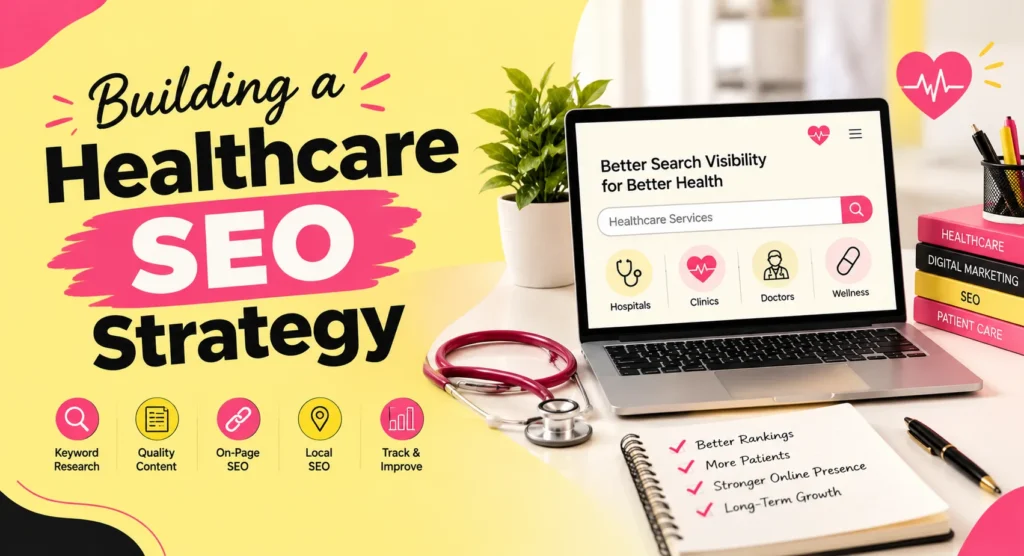
Five pillars comprise a comprehensive framework of clinic SEO strategies:
1. Service page architecture: Your clinic needs a dedicated, optimised page for every treatment or speciality that you offer. “Multi-location clinics need a page for each location for SEO — not a list of ‘our locations.’” These pages should include the service name, location keywords, practitioner details and a clear booking call to action.
2. Healthcare Content Marketing: Patient-centric content marketing builds organic traffic and authority at the same time. Publishing condition guides, treatment explainers and symptom-based articles consistently helps patients at the research stage and signals topical authority to Google. If you’re doing healthcare content marketing, internal links directly to service pages are the most effective.
3. On-Page Optimisation: Title tags, meta descriptions, H1S, and header structure should naturally reflect target keywords. Use unique, descriptive title tags per page, not “Home” or “Services.” Where clinics with otherwise decent websites are losing the most ground is in on-page medical content optimisation.
4. Authority for healthcare link building is derived from external sources – professional bodies, local press, health publications and medical directories. It includes guest articles from your practitioners on credible health sites, listings in association directories and local PR. Links from reputable medical and local sources are far more powerful than generic link building techniques.
5. Healthcare SEO Audit: A healthcare SEO audit is a periodic review of all of the above: technical health, keyword rankings, content gaps, local citation accuracy and link profile. See it as a quarterly MOT for your online presence in the clinic – finding out what’s working, what’s slipped and where the next opportunity is.
How to Know If Your Clinic’s SEO Is Actually Working
If you can’t measure healthcare lead generation through SEO, it’s useless. Key metric monitoring:
- Organic traffic: Total sessions originating from search engines, tracked in Google Analytics 4. View which service pages are driving visits by landing page.
- Prioritized local pack rankings: How effective are you at ranking for your prioritized local terms? Keep track of these separately from organic rankings. The visibility of your pack and your page one rankings are two different things.
- Google My Business signals: Calls made, directions requested, and visits made to your website from your GMB listing are hard signals that your local SEO efforts are resulting in patient intent.
- Conversion rate: What percent of visitors from searches to your site actually complete a contact form, call you, or take action? Although the volume of traffic is not everything when it comes to SEO for online appointment bookings, keep track of booking rate compared to traffic volume.
- Keyword Rankings: Monitor a selected 20-30 keywords. You will see noticeable progress within 3-6 months and even greater progress within 9-12 months.
Gains in healthcare website ranking are seldom linear – be ready for a few dips along the way, especially right after Google algorithm changes. Measure using a rolling average for three months to get the true trend.
Hiring an Agency vs. Doing It Yourself: What’s Right for Your Clinic?
The honest answer: outsource, at least partly, for most clinics.
Medical practice marketing is a mix of clinical knowledge, SEO technical skills, content production and local optimisation – a combination rarely found in one in-house hire, especially at a small or mid-sized practice.
When in-house: Clinics with dedicated marketing coordinators that can be trained in SEO basics, with external specialists for technical and strategic work. Google ranking for clinics can be controlled in-house if someone owns the process and has the time to execute consistently.
When to outsource: Competitive urban markets, multi-location clinics, practices starting new specialities, or any clinic that has attempted DIY SEO without traction. Specialist medical SEO agency services provide healthcare-specific expertise – knowledge of YMYL, E-E-A-T, and the regulatory constraints that a generalist agency might not understand.
What to look for: Proven experience working with healthcare clients, transparent reporting, no black-hat link building and a content process that involves medically qualified reviewers. If you want to do hospital and clinic SEO at scale, you need agencies that understand the technical and compliance aspects of the industry.
Red flags: Promises of a “#1 ranking” (no one can promise this), link schemes, keyword-stuffed content without clinical oversight, and agencies that can’t clearly explain their methodology.
Your Questions About Health Clinic SEO, Answered
How quickly does SEO work for a health clinic?
With continued effort, you should see early movement in local rankings within a couple of months or so. Organic traffic really doesn’t start growing until about six months, with big results coming between nine and twelve months. Medical practice SEO is not a quick fix. It is a long-term investment.
Should My Clinic Have a Blog?
Yes – for competitive local markets or clinics that want to build authority in a speciality. Medical blog SEO is about symptom and condition searches that service pages can’t rank for and bringing readers into bookings. A blog also tells Google you have depth on the topic.
What distinguishes standard SEO for clinics from local SEO?
Local Search Optimisation for Clinics is about getting ranked in the map pack results and location-based searches. General SEO is about generic organic rankings. Most clinics need both—local SEO to get in front of patients ready to schedule an appointment, and general SEO for condition and treatment content that builds authority over time.
How do patient reviews impact SEO?
Patient reviews are a major local ranking factor. A clinic’s Google Maps ranking and visibility in the local pack is influenced by volume, recency and rating. Reviews are also a direct factor in whether or not a patient books after finding your clinic – a dual SEO and conversion asset.
What is Schema Markup? Is it something my clinic needs?
Healthcare schema markup is a form of structured data code used to help Google understand the type, location, services, and content of your clinic. Yes, every clinic website needs it, especially MedicalClinic, LocalBusiness and FAQPage schema at the very least.
Can a clinic owner do SEO by himself?
You can do the basics – updating your Google Business Profile, creating reviews, and posting consistent blog content. But technical SEO for medical websites, healthcare link building and competitive keyword strategy typically need specialist support to be done well.
What does YMYL mean for what I can publish on my clinic’s website?
For healthcare websites, YMYL (Your Money or Your Life) SEO means that Google expects your content to be more credible and accurate. Avoid unsupported health claims. All content should be clinically reviewed. Articles must be attributed to named professionals. Keep information current. If your site does not meet YMYL standards, your rankings will be suppressed – regardless of how technically well-optimised your site is.