Every day, thousands of homeowners, developers and project managers are browsing the web with queries such as “commercial builder near me”, “residential contractor in [city]” or “best construction company for office fit-out”. The businesses that come up at the top of those results get the calls. The others don’t.
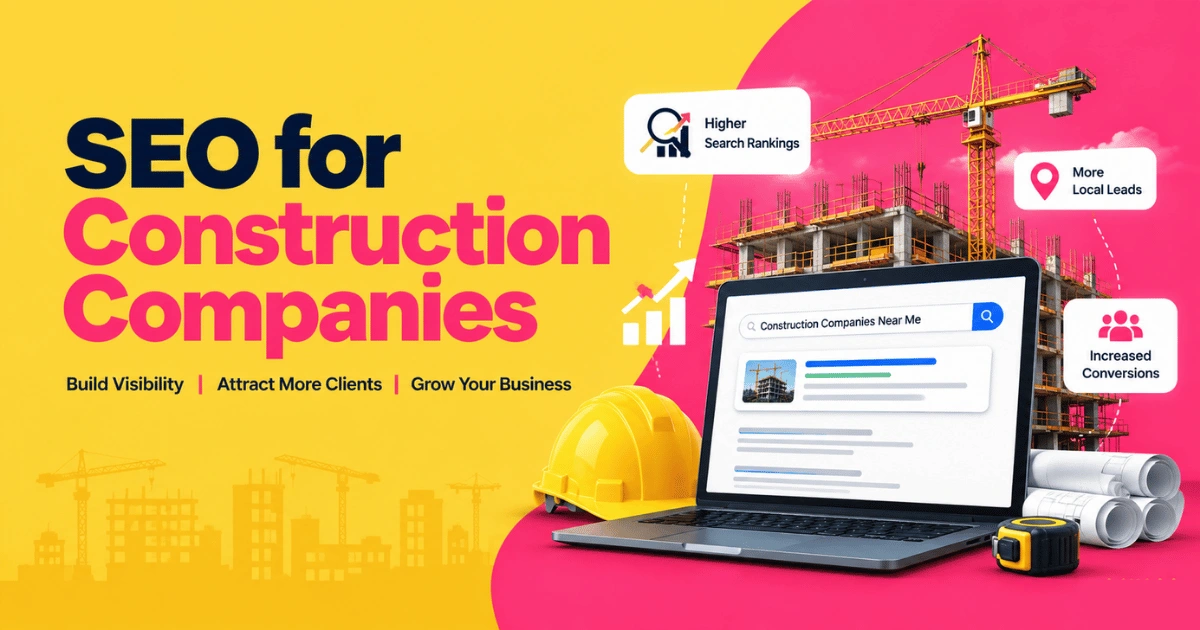
SEO for construction companies is how you keep your business on top — not by coincidence, but by design.
This guide is written for construction business owners, in-house marketers, and anyone researching SEO for construction companies, or considering construction SEO services for the first time or looking to upgrade their current strategy. You’ll walk away with a complete, actionable roadmap – from foundational keyword research to local SEO, content creation, technical fixes, link building and performance tracking. No bullshit. What works in 2026.
What Is SEO for Construction Companies?
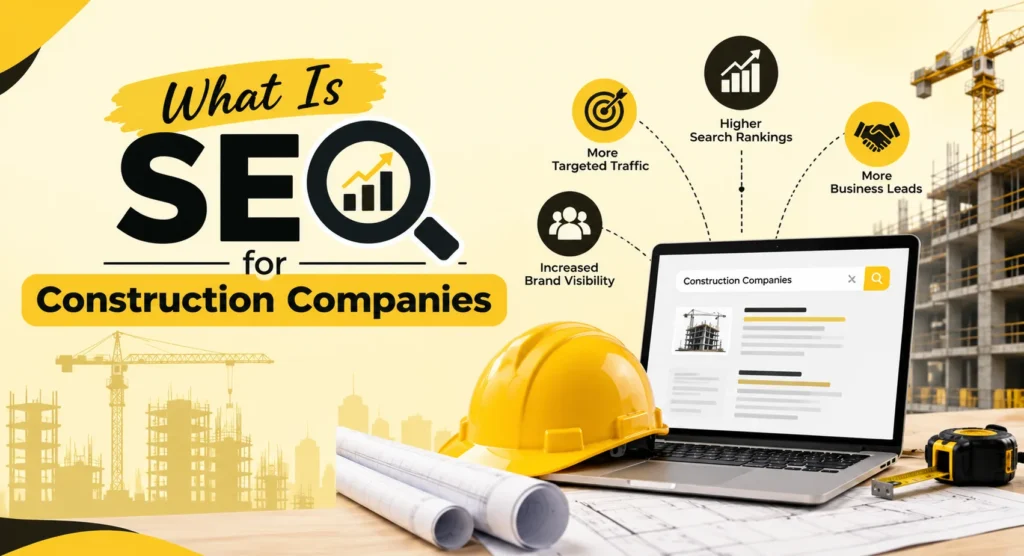
For construction companies, SEO is making sure your website and online presence are optimized so that your company appears at the top of Google and other search engine results when prospective customers are seeking for construction services.
It is a combination of four core disciplines,
| SEO Pillar | What’s included: |
| On-Page SEO | Keywords, Page Titles, Headings, Content of Service Page, Meta Descriptions |
| Local Search Engine Optimisation (SEO) | Google Business Profile, reviews, local citations, and map rankings |
| Technical Search Engine Optimisation | Site speed, mobile-friendly, crawlable, schema markup. |
| Off-Page SEO | Backlinks, online directories, authority signals, brand mentions, etc. |
Paid advertising stops producing leads the minute you stop spending. Construction SEO creates compounding, long-term visibility. A well-optimised website continues to rank and generate leads months — sometimes years — after the initial work is done.
No matter if you’re a general contractor, residential builder, commercial fit-out specialist or niche trade contractor, SEO for construction companies is the most budget-friendly long-term investment in digital marketing for construction companies out there.
Why SEO for Construction Companies Is Important in 2026
Traditionally, the construction industry has relied on referrals, trade directories and word of mouth to win new business. That model is still useful even if it no longer works on its own.
What’s new:
- According to BrightLocal’s Local Consumer Review Survey, 96% of consumers research local businesses online before making contact.
- WebFX’s construction industry stats show that 62% of people will ignore a business that doesn’t have an online presence.
- Google’s AI-powered local packs now appear at the top of many construction-related searches, which means businesses that aren’t optimising their profiles and content are missing the very first thing searchers see.
- Mobile-first searches for contractors have exploded. Mobile users lead the searches for “plumber near me,” “roofer open now,” “construction company in [city],” and more.
The result? Digital marketing for construction companies has gone from optional to mandatory. And in that ecosystem, SEO is the channel that has the best Cost-Per-Lead ratio over time. The Construction Marketing Association states that SEO users in construction are 85% more likely to see an increase in site traffic than PPC.
The construction companies investing in SEO today are the ones dominating their local markets in 2026. Those that don’t are giving projects to competitors.
Construction Company Keyword Research
Construction company keyword research is the basis for every other SEO decision you make. If you’re targeting the wrong keywords, all the content and link building in the world won’t help.
How to Think About Construction Keywords
There are three kinds of construction searches:
High-intent service keywords – Searches by people ready to hire:
- “Chicago building firm”
- “home addition contractors near me”
- “office fit out builders in London”
Informational keywords – people researching:
- “How much does a loft conversion cost?”
- “Things to Consider When Hiring a Contractor”
- “Guide to Construction Project Schedules”
Geography-based searches – local keywords:
- “construction company [city name]”
- “best builder in [neighbourhood]”
- “residential contractor [zip code/postcode]
Main Keywords to Target
The main aim for most construction businesses is SEO for construction companies (if you are an agency) or service + location combinations (if you are a builder). Here is what a typical keyword map looks like for a general contractor.
- Homepage: “building contractor [city]”
- Residential page: “home builder [city]” or “residential contractor [city]”
- Commercial page: “commercial construction [city]” / “office construction [city]”
- Blog: long-tail informational keywords (“how to pick a builder”, “construction timeline explained)
Tools for Construction Keyword Research
Make use of both premium and free tools:
- Google Search Console – find out which queries are already bringing traffic to your site
- Google Keyword Planner – discover search volume for construction keywords
- Ahrefs / Semrush – competitor keyword gap analysis
- Google Autocomplete – Type in your core services and see what Google suggests
Pro Tip: Focus on keywords with clear local intent (e.g. “construction company in Manchester”) rather than broad national terms (e.g. “construction company”). Local terms have less competition, more purchase intent and faster timelines to rank.
On-Page SEO for Construction Companies Websites
Page-Level SEO for a Construction Website is about making sure that every page on your site is well-structured, keyword-focused, and compelling enough to keep visitors engaged.
Service Pages: Your Greatest On-Page Opportunity
Make a site specifically for each of your construction company’s primary services. Google SEO for construction companies requires more than a single “Services” page explaining everything – Google needs to understand the depth of each offering.
Each service page should contain:
- Title tag: Keyword + location (Example: “Commercial Construction Services in Leeds | [Company Name]”)
- H1 Heading: Well-written, keyword-matched service description
- 300–600 words of body content: What the service involves, who it’s for, your process, and why clients choose you
- FAQs: 3- 5 frequently asked questions about that service (good for voice search and featured snippets)
- Social proof: Relevant testimonial or project reference
- Call to action: A single, obvious next step (“Call us,” “Get a free quote,” “View our project portfolio” )
Location Pages for Multi-Area Contractors
Build location landing pages if your construction business serves more than one town, city, or region. A page on “construction company” should have:
- A distinctive description of your work in that field
- Photos from local projects
- References to local landmarks, planning authorities or regulations as appropriate
- An embedded Google Map of your office or service area
This is the cornerstone of local SEO for huge construction companies.
Meta titles and meta descriptions
Each page needs a unique meta title (less than 60 characters) and meta description (less than 155 characters) that is keyword-aware. The meta description doesn’t directly affect rankings, but it does affect the click-through rate, and that does.
Local SEO for Construction Companies
Local SEO is the single most important piece of the entire construction company SEO strategy for construction companies. Because most construction work is location-based, the best leads for construction businesses are usually from the local pack on Google (the map-based results at the top of the search results).
Optimising your Google Business Profile
The cornerstone of local SEO for construction companies is your Google Business Profile (GBP). A well-maintained GBP can land your business in the local pack for dozens of relevant searches without you spending a single dime on advertising.
Fill out every section of your GBP:
- Business Name (exactly the same as your legal name; don’t stuff it with keywords)
- Primary and Secondary category (eg “General Contractor” + “Home Builder”)
- Location & Service Areas
- Phone number & web address
- Business hours (including special/holiday hours)
- Keyword-rich business description (max 750 characters)
- Photos: Exterior, Interior, Our Team, Active Job Sites, Completed Projects
Regularly post: Share project updates, seasonal promotions and company news through GBP Posts at least twice a month. It proves to Google and potential customers that you’re a legitimate, busy company.
Reviews: The Currency of Local Trust
One of the most significant trust signals in the construction business and one of the most potent Google Business Profile ranking criteria is online reviews. Clients spend a lot of money on construction projects — they do their homework, and reviews are a big part of that.
How do you build your review pipeline:
- At project handover, ask satisfied clients directly: “Would you mind leaving us a Google review? It really helps our business.”
- Send an email or SMS with a direct link to your GBP review form.
- Include a QR code on business cards, invoices, and site signs.
- Respond to each review, thank positive reviewers by name and address negatives constructively
If you have a consistent stream of authentic 5-star reviews, you will outrank competitors who have more reviews but have stopped getting new ones.
NAP Consistency & Local Citations
One crucial component of local ranking is NAP consistency across various web directories. Inconsistencies – even small ones like “Ltd” vs “Limited” or a phone number with and without country code – confuse Google and suppress your rankings.
Create and manage your citations at:
- Yellow Pages / Yell.com
- Checkatrade / Rated People / Houzz (UK)
- Angi / HomeAdvisor / Houzz (USA)
- Better Business Bureau (USA)
- Trustpilot Reviews
- Chamber of Commerce directory
- Industry-specific directories (e.g. BuildZoom, ConstructionLine)
Do a quarterly citation audit to identify and remedy inconsistencies before it gets out of hand.
Content Strategy for Construction Companies
Content is what gets construction company SEO rankings for informational searches, and is a foundation of good SEO for construction companies — it demonstrates your expertise and retains visitors long enough on your site to convert.
What is Good Content for Construction Companies?
Case studies of projects: Writing in detail about projects you have completed – the brief, your approach, timeline, challenges you overcame and the result – is some of the most powerful content a construction firm can publish. They show their competency, create trust and rank for local keywords organically.
How-to guides and cost guides: Thousands of people are searching every month for “How much does a kitchen extension cost in 2026?” and “What permits do you need for a loft conversion?” Ranking for these types of queries puts your brand in front of the right audience, at the research stage.
Comparing content (e.g. “Timber frame vs brick build: which is right for your home?” or “Design and build vs traditional procurement: pros and cons”) puts you in the position of being a knowledgeable advisor, not a vendor.
Establish an FAQ page/section for addressing pre-hire queries like “How much time does the permission process take?” and “Am I supposed to hire a structural engineer?” to get ranked for voice searches on Google.
Video Content: Embed short project tours, time-lapse builds, and behind-the-scenes team videos on your website and upload them to YouTube for a second channel of search traffic.
Construction Companies Content Calendar
| Type of Content | Frequency. | Objective |
| Case Study Project | Monthly | Establishing confidence and local ranking |
| Cost guide / How to | Bi-monthly | Lead-nurturing informational traffic |
| Blog post faq | Monthly | Voice Search Featured Snippets |
| GBP after | Twice a month | Brand activity, local rank signals |
| Video project update | Quarterly | YouTube SEO, Engagement. |
Even publishing one good article per month on a regular basis really adds up over a period of 12-18 months and is a key element of successful online marketing for contractors.
Technical SEO for Construction Companies Websites
Technical SEO ensures that Google can crawl, index and find your site efficiently — and that visitors to your site have a fast, smooth experience on any device.
Site Speed
Construction websites often have lots of heavy images from project galleries. Slow load times kill rankings and conversion rates both. Get a green score for Core Web Vitals in Google’s PageSpeed Insights.
Low-hanging fruit:
- Resize and compress all images before uploading (use WebP format)
- Utilise a content delivery network (CDN)
- Enable browser cache
- Minify HTML, CSS & JavaScript
Mobile Optimisation
Over 60% of local construction searches occur on a mobile device. If your website is hard to navigate on a smartphone – small text, buttons too close together, horizontal scrolling – you’re losing leads before they’ve even read your first sentence.
Run Google’s Mobile-Friendly Test on your website once a month. Include a clickable tel: link to your phone number at the top of each page.
Schema Markup
Schema markup is a kind of structured data that assists Google to understand your content better. For construction companies, implement:
- LocalBusiness schema: Check your name, address, phone and opening hours
- Tags service schema: Each type of service
- Review schema: Shows star ratings in search results
- FAQPage schema: Display your FAQ answers as expandable rich results directly in SERPs
Core Technical Checklist
- HTTPS: SSL certificate in use and enforced
- Clean URL structure: /services/loft-conversions/ instead of /page?id=47″>
- XML sitemap: Submitted to Google Search Console
- Robots.txt: No accidental blocking of important pages
- Internal links: Logical cross-linking of service pages and blog articles
- No broken links: Audit monthly with Screaming Frog or Ahrefs.
Link Building for Construction Companies
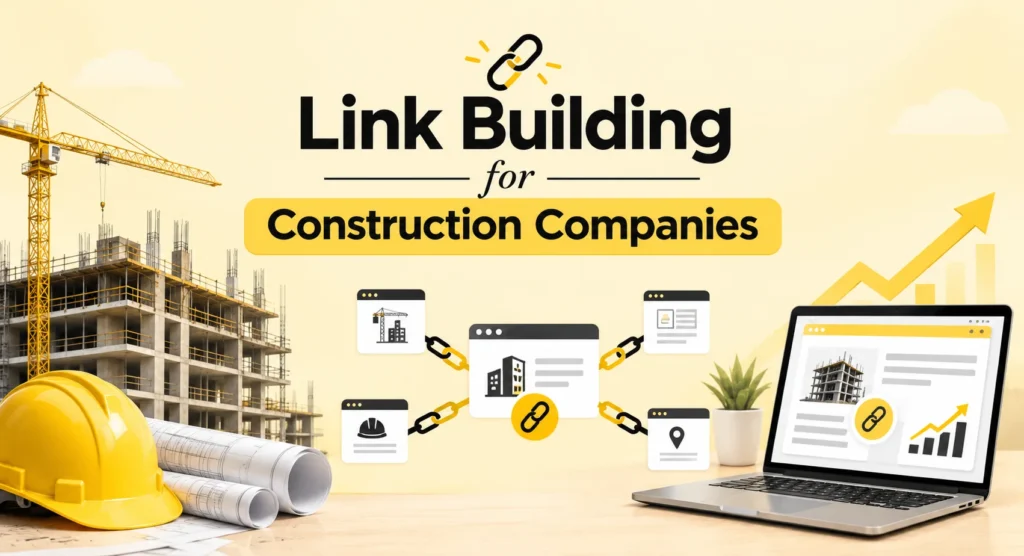
Google considers backlinks – links coming to your site from other websites – some of its strongest ranking factors. In the realm of marketing a construction company via search engine optimization (SEO), the difference between page 3 results and the local pack lies in good backlinks.
Effective Link Building Techniques for Construction Companies
- Local Business Directories: Get your business listed in all the well-known local and national business directories. Each listing is a citation (NAP consistency) and most of the time a backlink too.
- Industry associations: List your company and become a member of local chambers of commerce, the Federation of Master Builders (UK), and the Associated Builders and Contractors (US). They have high domain authority and editorial trust.
- Supplier and partner pages: Request your material suppliers, equipment hire companies and professional subcontractors to link to your site on their “trusted partners” page. Offer to do it for you as well.
- Local news & PR: Get links from local news outlets via coverage of a big project, community project or charity sponsorship. Pitch project completions or pitch local journalists with interesting stories.
- Guest content: Write articles for architecture blogs, trade publications or local business websites. A 500-word piece on an industry site about “what to look for when hiring a commercial builder” earns a high-value backlink.
- Project Features Before and After: Do post your finest case studies on ArchDaily, Houzz, or your local lifestyle publications.
What to stay away from: Paid link schemes, spammy directory sites, link rings. Google has sophisticated spam detection, and it costs a lot to recover from a penalty. Build links the right way – slow and steady with relevance and quality as the gate.
SEO for Residential vs. Commercial Construction
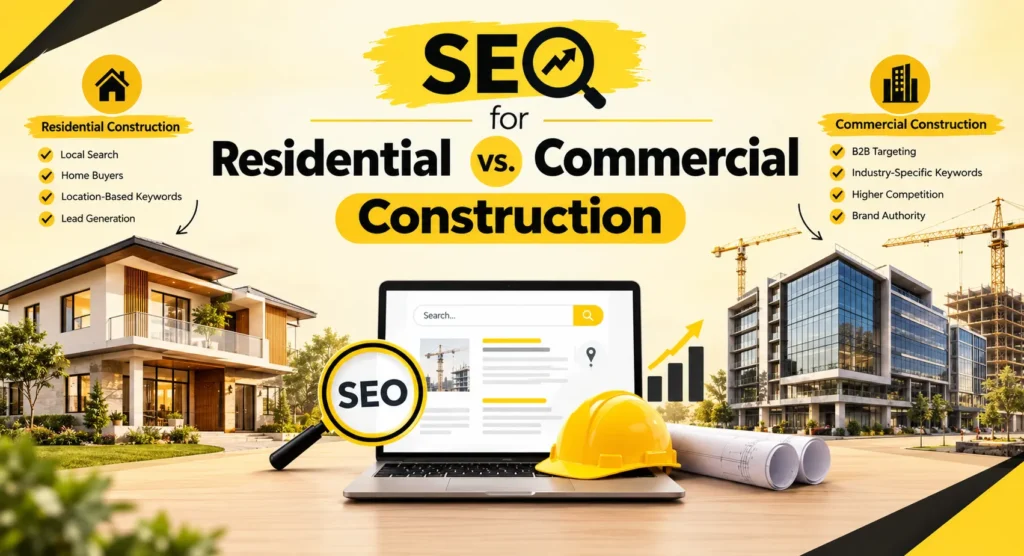
SEO for residential construction companies vs. SEO for commercial construction companies are based on the same principles, but the audience, keyword intent, and content strategy are extremely different.
SEO for Residential Builders
Residential customers are typically homeowners looking for emotional reasons like building their dream home, expanding for a growing family, or increasing property values. They do a lot of research online and are very reliant on reviews and photos of projects.
Residential SEO Primary Tactics:
- Target keywords for “home extension contractor in [area]” at the neighbourhood and city level
- Invest hugely in project photography and before/after galleries
- Build a strong review profile. Residential clients are obsessed with reviews
- Create cost guides (everyone wants to know “how much will this cost?”)
- Make your site mobile-first – most residential searches are done on phones
Commercial Construction SEO
Developers, property managers, retail chains and facility directors are all commercial clients, each with their own priorities. They are about capacity, compliance, program management and reliability. Decisions aren’t made from a single search all that often.
Key commercial SEO tactics:
- Develop detailed case studies with quantified benefits (project value, timeline, square footage)
- Clearly display credentials, accreditations and safety records
- Create downloadable guides and white papers to capture B2B leads
- Optimise for secondary search channel LinkedIn for B2B decision makers
- Target keywords at procurement stage (“design and build contractor for retail”, “warehouse fit-out specialist”)
Both segments have strong construction lead gen through organic search, but the content, voice, and conversion path look very different.
How to Track and Measure Construction SEO Results
SEO for construction companies is more than just doing things, it’s about knowing which things are working and doing more of them.
Essential Tools
- Google Search Console (free): Tells you exactly what search queries your site appears for, what your average position is and how many clicks you are getting. Look at this monthly.
- Google Analytics 4 (free): Helps you understand where your website traffic is coming from, what pages people land on, how long they stay, and if they convert (call, form submit, direction request).
- Google Business Profile Insights (free): Shows you how many people found your GBP listing, what they searched for and what they did (call, website, directions).
- Ahrefs / Semrush (paid): Tracks your keyword rankings over time, tracks your backlink profile, and benchmarks you against competitors.
Key Metrics to Review Monthly
| Measure | Tool | What it says to you |
| Natural traffic | Google Analytics | General SEO growth trend |
| Keyword positions | Ahrefs / Search Console | Target Keyword Visibility |
| Local Pack Visibility | GBP Insights | Local search ranking |
| GBP calls and direction requests | GBP Insights | Local leads with high intent |
| Conversion Rate (calls/forms) | GA4 | If traffic is turning over |
| Backlinks acquired/lost | Ahrefs. | Link building steam |
Set up a monthly review cadence. Track success quarterly, not weekly – It takes 3-6 months to see results with SEO for construction companies, and the growth is exponential at 6-12 months. Not only traffic, but quality leads that result in contracts.
How to Choose the Right SEO Agency for Your Construction Business
At some point, many construction companies realise that DIY SEO just isn’t enough — whether it’s because they’re facing increased competition, expanding into new markets, or just don’t have the in-house capacity. By now, you know you need to hire an SEO agency for construction companies.
Here’s how to assess your options:
What to watch for
- Industry experience: An agency that has worked with construction companies understands the sales cycle, the local search landscape and what content resonates with your audience. Ask other customers of construction or trade contractors for case studies.
- Transparency: You should receive monthly reports that include keyword rankings, traffic, leads attributed to SEO, and the specific work performed during that month. Avoid agencies that lack clarity in what they’re doing or why.
- Set realistic expectations: Reputable construction SEO service providers will tell you that it takes 3-6 months to see results with SEO. An agency is either lying or using strategies that will result in your website being penalized if they claim to be able to make you “#1 on Google in 30 days.”
- Full-stack capability: The top agencies are doing keyword research, content, technical audits, local SEO, and link building. Not just a few of them.
Red Flags to Avoid
- No verifiable client references or case studies
- Vague or locked-in contracts without performance clauses
- Using black hat techniques (keyword stuffing, link farms, spun content)
- Providing the same “packages” to all clients without customisation
- Poor communication or delayed response times
When looking for cheap SEO for construction companies, remember the lowest price is not usually the best deal. In terms of increased project inquiries, a well-executed SEO strategy will provide a 5–15x return on investment, which significantly alters the monthly investment.
Final Thoughts: SEO for Your Construction Business in 2026
SEO for construction companies is not a quick fix. It’s a strategic investment in your business’s ability to generate consistent, qualified leads from the web – month after month, without paying for every click.
The construction industry is a competitive one. Consumers have more options than ever, and they’re doing more homework before they pick up the phone. The firms that appear at the top of Google when those searches are made didn’t get there by accident. They’ve invested in a full SEO campaign for their construction company that’s well executed: targeted keywords, optimised service pages, strong local presence, consistent content, and quality backlinks.
Start with the basics – claim your Google Business Profile, improve your site speed, build out dedicated service pages and ask every happy client for a review. Then slowly build in the advanced tactics.
Whether you do it yourself or you partner with a specialised SEO agency for construction companies, the direction is the same. Build your online presence systematically, measure what works and keep moving. The companies that win the most inquiries in 2026 are the ones that started doing this seriously 12 months ago.
This is the best time to begin.
FAQs on SEO for Construction Companies
How long does it take for SEO to start working for construction companies?
Within three to six months of implementing a comprehensive approach, the majority of construction businesses will start to see noticeable increases in rankings and traffic. 6-12 months for competitive local markets. Results build up over time – the longer you invest, the better your returns.
What’s the most important part of SEO for a construction company?
Local SEO for construction companies — especially Google Business Profile optimisation and review building — delivers the fastest return for most construction businesses. It impacts your visibility in the local pack, where most high-intent construction searches result in contact.
How much does SEO cost construction companies?
Costs vary widely. A freelancer might charge £500-£1500/month. A specialist agency typically charges £1500-£5000+/month depending on scope, location and degree of competition. Bigger companies with multiple locations or companies in competitive markets should budget on the higher end.
Can I do SEO on my own for my construction company?
Yes—especially if you’re starting from scratch: verifying your Google Business Profile, making sure your site loads quickly on mobile, targeting the right local keywords, and asking your clients for reviews. For most small construction firms, these alone will make the difference. The more competitive your market, the better a specialist will be.
What keywords should construction companies focus on?
Begin with your basic services combined with your town or area: “home builder in [city],” “commercial contractor [city],” “loft conversion specialist [area].” Then move on to long-tail informational keywords: “Do I need planning permission for a garage conversion?”.
SEO vs Google Ads: What’s Best for Construction Companies?
Both are involved. Google Ads (PPC) – Immediate visibility, great for startups or time-sensitive campaigns. SEO takes longer in the beginning, but it has a compounding effect without additional cost in the form of ads. Most growing construction companies use both – PPC for short-term lead generation and SEO for long-term authority and reduction of cost-per-lead.
What is the difference between local SEO and standard SEO for construction companies?
For construction companies, local SEO is all about ranking for geographically targeted searches and Google’s local pack (the map pack). This includes managing your Google Business Profile, local citations, review strategy and location-specific content. Regular SEO uses backlinks and content to rank in the organic (as opposed to map) results. For most construction firms, local SEO should be your first concern.
Continue Reading: SEO Reputation Management