
Most businesses can afford to ignore SEO without losing search rankings. They fail because they are doing what they were told years ago. Sprinkle in a few keywords, get a handful of links, write a blog post every week and hope for the best. Search is changing. Google has begun to understand meaning rather than string matching, AI-generated answers appear at the top of organic results, and consumers want to see relevant pages that fix their problems immediately.
This guide walks you through the SEO strategies that matter today, why they work, and how to put them into practice. For local small businesses and content management teams, it can be applied as a practical playbook rather than a theoretical concept.
What SEO Really Is
SEO is the practice of making your website easy for search engines to find, understand and recommend, and making it genuinely useful for the people that show up. Look at the two audiences. Pages built purely for algorithms feel sparse and robotic. Pages built for humans, without any thought for structure or technical health, are never found.
SEO does not involve magic. It also does not happen once and for all. Rather, it works like compound interest. Doing quality work in certain areas will result in authority that will be difficult to overcome by your competitors. It rarely gives you results overnight, but it often has the lowest cost per customer of any marketing channel once it gets going.
How Search Has Evolved
The three shifts inform every strategy below.
Search engines get intent. So what? Today’s systems look at more than just the words someone typed; they look at what they’re trying to do. A page that matches the intent of a search query is better than a page that simply contains the phrase.
The results include answers that are generated by AI. AI Overviews and other features offer summary information and source citations. The goal of visibility has changed to citation rather than ranking. At the same time, people are also asking questions directly in AI assistants, which pull from well-structured, authoritative content.
Quality signals are more important. The systems at Google reward those web pages that reflect authenticity, and punish those which are designed purely for capturing traffic. Lightly edited, mass-produced material is starting to become a liability.
Fortunately, these systems are satisfied by the same foundations that please human readers. The strategies below are listed from the foundational to the growth stages.
List of SEO Strategies
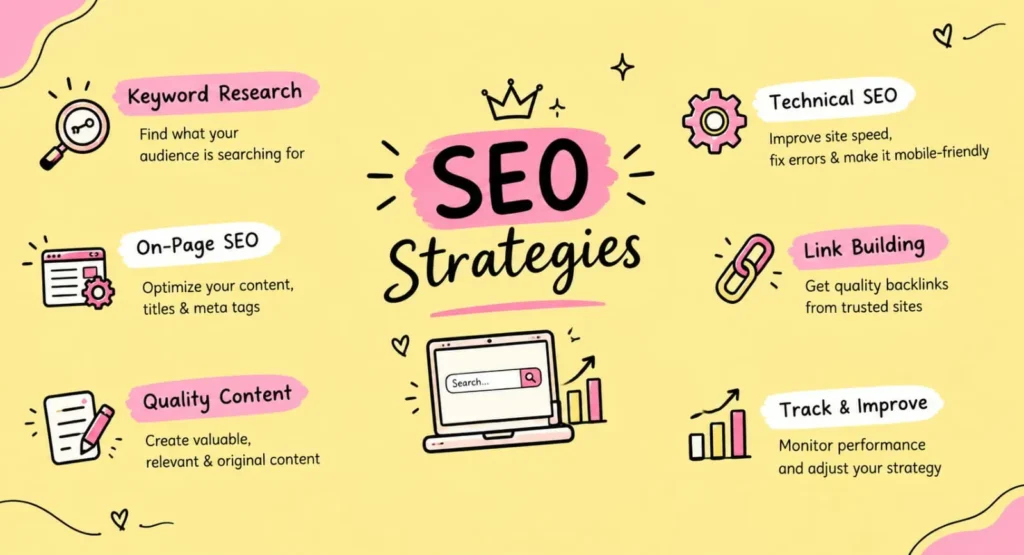
Strategy 1: Focus Your Entire Effort on Search Intent
Ask yourself what the searcher wants before you write one word. ANearly all inquiries fall into one of four categories:
- Informational: the person wants to know something (“how does schema markup work”)
- Navigational: the person is looking for a particular site or brand.
- Business research: The person is considering their options (the best project management software for agencies).
- Transactional: The individual is prepared to act (“book SEO consultation”).
The best way to check intent is to search the keyword yourself and look at page one. If all top results are comparison lists, a product page won’t rank. A 4,000-word essay might go over if all the words are short definitions. Then, first match the dominant format, then beat it with more depth, better structure or fresher information.
Mapping intent also saves you from the common waste of attracting visitors who were never going to buy. A thousand informative visitors are worth nothing if your content does not motivate them to the next step. So attach each page to a logical next step, such as a related guide, a tool or a consultation.
Strategy 2: Create Topical Authority Rather Than Independent Posts
Search engines also increasingly favour sites that cover a subject thoroughly. Publishing an article on each of fifty unrelated topics says nothing. Write twenty connected pieces on a single topic to show your expertise on the subject.
The practical structure is the topic cluster:
- Pillar page: Comprehensive manual on a wide subject matter (such as “Local SEO”).
- Cluster pages: Articles on subtopics (creating a Google Business Profile, citation management, review strategy, local link building).
- Internal links: Each cluster page links back to the pillar, the pillar links out to each cluster page, and related clusters link to each other.
It helps crawlers understand how your content is linked and passes link authority to the pages that need it. It also benefits visitors: someone arriving on a narrow article can easily transition to the wider guide.
Choose two or three primary business subjects first, then evaluate what you currently have. You’ll often see gaps (missing subtopics) and overlaps (multiple weak pages fighting over the same keyword). Complete the gaps and blend the overlaps.
Strategy 3: Don’t Just Look at Volume for Keyword Research
A term that receives 200 monthly searches from purchasers may be worth more than one that receives 20,000 monthly searches from browsers; keyword research is still the first step, but the strategy has evolved.
Evaluate each keyword on four dimensions:
- Relevance: Does it relate to something you do well?
- Purpose: Is the person’s purpose aligned with what your page provides?
- Competitors: Who is ranking today, and could you realistically compete with their authority and quality? They are just estimates, therefore you have to double check the actual numbers.
- Business value: How much is a converting visitor worth?
Useful tools: Google Search Console (free and based on your real data), Google Trends, Ahrefs, Semrush, Moz, Ubersuggest. If it’s question-type ideas you’re after, check out the “People also ask” box, autocomplete suggestions and communities such as Reddit and industry forums where customers describe problems in their own words. Those are usually the key phrases to target.
For new websites, it is important to focus on long tail keywords (more specific phrases). These have less competition, better intent and higher conversion rate. Ranking for many such keywords will give you the clout to target the broader terms later.
Strategy 4: Develop Content with Unique Value
Many publications on the internet simply restate the same ten arguments. Stand out by adding something a reader can’t get from a competitor’s page. How to do that:
- First-hand experience: case studies, results of your own projects, mistakes you made and what you’ve learned.
- Data: a small survey of your customers, an analysis of your own metrics, or a benchmark that you track over time. The original data generates organic citations and links.
- Expert input: quotes and reviews from practitioners, with real names and qualifications
- Practical tools: templates, checklists, calculators and worksheets that make the content actionable.
- Clear opinion: An unbiased synopsis is less memorable than a well-reasoned point of view.
These are referred to as experience, expertise, authority, and trustworthiness (E-E-A-T) in Google’s quality requirements. You can’t simply turn it on as a ranking element. It’s a standard your content either meets or it doesn’t. Show it with named authors and short bios. Show it with cited sources. Show it with transparent business info, accurate claims and real consumer input.
On AI-assisted writing: Tools can speed research and drafting, but publishing unedited output rarely makes you stand out. Use them as assistants, then add your own examples, check every fact and edit for voice. The goal is to be content that a knowledgeable person would be proud to put his or her name on it.
Strategy 5: Become a Master of On-Page Optimization
On-page SEO informs search engines exactly what a page is about. Here’s what you need to understand:
An on-page SEO strategy begins with optimizing title tags, creating a good meta description, using the right H1, and having properly structured H2s and H3s that respond to people’s queries. Use human language that sounds nice when read aloud, add internal links with descriptive anchor text, make sure your opening paragraph discusses the key idea, use clear and readable URLs that appropriately represent the page content, and employ a variety of strategies to improve readability.
Don’t ignore structured data (schema markup). To give more details to the search engines regarding the type of your content and get better listings, you need to include relevant schema types, such as Article, FAQPage, Product, LocalBusiness, or Review. You should check it using Google’s Rich Results Tester.
Strategy 6: Shore Up Your Technical Foundation
If search engines are unable to crawl great content or if users leave, it cannot rank. A solid technical foundation means:
Crawlability and indexing. Verify if Search Console is indexing key pages. Keep your XML sitemap current, make sure you don’t inadvertently block pages in robots.txt or with noindex tags and fix redirect chains and broken links. Use canonical tags for duplicate-content resolution.
Site speed and Core Web Vitals. Google measures loading speed (Largest Contentful Paint), interaction (Interaction to Next Paint) and visual stability (Cumulative Layout Shift). Images should be compressed, contemporary formats like WebP or AVIF should be used, Images must be compressed, current image formats such as WebP and AVIF must be employed, excessive scripts must be avoided, caching must be enabled, and a CDN should also be considered. Test with PageSpeed Insights
Mobile Experience. Mobile users see everything, as Google indexes the mobile version of your website. Texts must be readable, buttons must be touchable, and there shouldn’t be anything that is not visible on mobile devices.
Security & Structure. HTTPS is mandatory for all the website pages, a shallow architecture (pages should be reachable in a few clicks from the home page), and use of breadcrumbs.
JavaScript rendering. If your website uses a lot of client-side JavaScript, make sure that important content is presented as HTML and use the URL Inspection tool.
Technical audit quarterly. Make use of a crawler such as Site bulb or Screaming Frog. Fix in order of impact. Indexation problems, speed, minor tidying.
Strategy 7: Make AI Search and Answer Engine Optimizations
Visibility is now incorporated into AI-generated responses. While there can be no guarantee of citations, there are certain practices for success:
- Keep your answers simple. Put a brief, clear answer at the start of a section and develop with detail and context.
- Structure for mining. Systems can easily parse and quote clear headings, bulleted steps, comparison tables, and definition-style sentences.
- Be specific and verifiable. It’s easier to cite exact claims, sources, numbers, and dates than to cite generalities.
- Improve entity signals. Claim who you are: consistent business name and details, an About page, author pages, and profiles on relevant platforms. Use Person and Organisation schema where appropriate.
- Be mentioned elsewhere. The wider web is used by artificial intelligence (AI) systems. Being mentioned in industry publications, reviews, forums and directories builds your credibility.
- Let them in. Make sure that your robots.txt isn’t blocking crawlers that you want to be seen by.
Keep track of this visibility by tracking brand mentions and referral traffic from AI tools and by periodically asking relevant questions in major assistants to see which sources are returned. Think of it as a new channel, not a replacement for traditional SEO. Both are supported by the same quality signals.
Strategy 8: Update and Repurpose Old Content
One of the biggest inefficiencies in SEO is the never-ending publishing of old pages that decay. Writing something new may not get as good results as updating a page that has rankings, links and history.
Use Search Console to look for pages that:
- rank between 8 and 20 (near page one),
- are seeing year-over-year declines in clicks, or
- get tons of impressions but few clicks.
Then improve them meaningfully. Update stats and screenshots, add missing subtopics that top competitors cover, tighten the introduction, improve the title and meta description, add internal links from newer content and add a visible “last updated” date. Don’t do cosmetic changes just to change a date. They add no value.”
For thin, outdated, and unlikely-to-recover pages, combine them into a stronger page and redirect the old URLs with a 301 redirect.
Strategy 9: Create Links with Genuine Value
Backlinks still are one of the most powerful authority signals. A link from a trustworthy, relevant site is like a vote of confidence. However, quality trumps quantity. A few editorial backlinks from credible sources will always be more valuable than hundreds of low-quality backlinks, and manipulation can cost you dearly. Sustainable methods include:
- Linkable content: Research, software, tutorials, etc. that other people will like to link to.
- Digital PR: Offer journalists data or insight that is worth writing about. Platforms and services connecting experts with reporters can help.
- Guest posts and podcasts: Put your real expertise to work to reach the right audience, not just for a link but for readers.
- Partnerships and sponsorships: Local events, associations, suppliers and community organisations often link to their partners.
- Approach broken links and resources: Market your content as an alternative to broken links and missing resource pages.
- Mentioned without a backlink: Contact individuals who have mentioned your brand name and request a backlink from them.
Outreach is most effective when it’s personal and has value. Template spam is skipped. Be prepared for slow link building. Judge link building on relevance and authority of links you receive, not on the number of links.
Strategy 10: Win the Local Search
If you cater to the people in a particular area, then the best ROI would come from local SEO. When someone searches for “dentist near me” or “plumber in Dallas,” Google usually displays a map pack heavily populated with Google Business Profiles.
Main activities:
- Claim your Google Business Profile and complete it. Add accurate categories, services, hours, photos and a full description. Keep information current, including holiday hours.
- Maintain consistency of the NAP. Make sure that your company’s name, address, and telephone numbers remain consistent across all online platforms, including your company website, listings on directories, and social media sites.
- Get and reply to reviews. Always request reviews from satisfied customers regularly as a standard practice, but not in exchange for anything in return that would violate the guidelines of those platforms.
- Create local pages. If you have more than one service area, make really useful pages for each with local information, not the same generic page with the city name changed.
- Add a local schema and embed a map where applicable
- Get local links and citations from chambers of commerce, local news, and community sponsorships.
Reviews and proximity are huge factors in local rankings, so a systematic review process pays off in the long run.
Strategy 11: Improve your images and multimedia
Images and video are traffic magnets in and of themselves and make pages more engaging.
- Use descriptive file names (red-brick-office-dallas.webp, not IMG_4032.jpg)
- Create good alt text that is a good description of the image and works well for screen-reader users, including a keyword if it is a natural fit.
- Optimise images and set width and height to avoid layout shifts.
- Lazy load images below the fold
- Use your own images whenever possible: screenshots, diagrams, photos, etc. are more valuable than generic stock images.
- Include relevant videos and upload them to YouTube with strong titles and descriptions, as search often includes video results.
Good alt text also supports accessibility, which is the right thing to do. And it’s in line with how search engines measure page quality.
Strategy 12: Analysing the Competition
Your competitors have already done the experiments for you. By studying them, you can see what works in your market and where the opportunities are.
For each of your top competitors, check out:
- What keywords are driving them traffic, especially keywords you’re not targeting yet.
- What are their best pages and formats?
- Where their backlinks are coming from so you can go after link opportunities.
- Their content holes: questions they answer poorly or not at all.
- SERP features: are there video results, review stars, or featured snippets?
It’s not copying; it’s finding out where you can improve: more depth, a clearer explanation, a better design, newer data or a better real-world example. Your competitive analysis will help you understand the competition, while your expertise will show you how to win.
Strategy 13: Measure What Counts and Iterate
Measurement is the difference between guesswork and SEO. Establish your account on Google Search Console and Google Analytics (or another analytic tool) and track metrics that relate to your business results:
- Organic traffic by topic group and by page. Clicks.
- Rankings for priority keywords, tracked over time (not checked on a daily basis).
- Click-Through Rate, uncovering Opportunities for Title & Description
- Organic traffic conversions: calls, leads, sales, sign-ups.
- Engagement signals such as time on page and scroll depth, not diagnostics, not ranking targets.
- Authority signals (referring domains, brand-name search growth)
SEO changes take time to show, so check results monthly and report on trends quarterly. When it works, do it again. If you have a page that is underperforming, before you make any changes, diagnose whether the problem is intent mismatch, weak content, technical problems, or lack of authority.
Also Explore:
Common SEO Mistakes to Avoid
Focusing on keywords without looking at intent, which means pages never meet what searchers are looking for.
- Scaling thin or duplicated content.
- Mobile optimization and speed are not important.
- Link buying and link schemes.
- Going after new pages but forgetting the ones already existing.
- Nothing works and there is no way of measuring anything.
- Looking for quick results and stopping using this technique after three months.
90-Day SEO Plan
Days 1-30: Fundamentals. Configure Search Console and analytics. Perform a technical audit and resolve issues with indexation, speed and mobile. Map and research keywords by intent. Claim and optimise your Google Business Profile if you have customers in your area.
Days 31 to 60: Content and structure. Pick your priority topic clusters. Update your five to ten most promising existing pages. Publish the first pillar page and a handful of supporting articles. Enhance internal linking and add structured data.
Days 61-90: Authority and finesse. Promote one linkable asset like a tool or original data via outreach. Create a standard process for gathering reviews. Look at early results, double down on those that are gaining traction, and plan clusters for next quarter.
Concluding Thoughts
The winners of the search aren’t usually the ones who have the best tricks. They know their audience. They create content that solves real problems. They keep their sites fast and accessible. They earn trust over and over. Start with intent and technical health, build topical authority, earn links by adding real value and measure everything. Be patient about it, and you will not only outrank your competition, but you will establish a search presence that is much harder for them to copy.