
You write a well-researched article, you wait weeks, and it just barely makes it above page three. Meanwhile, a thinner piece competitor sits in position two. Most often, the difference is how precisely the content was optimised before it went live.
AI content Optimisation techniques are designed to address such issues. Rather than guessing what keywords to include, how long to write, or what sub-topics Google is expecting, these platforms analyze the top ranking pages for your keyword and give you data-backed guidance before you write a single word.
They’ve gone far beyond keyword checkers by 2026. Today’s platforms use NLP, TF-IDF scoring, semantic analysis and even AI Overview tracking to help your content compete in traditional search and in AI-generated answers. This guide covers the 12 best AI content optimisation tools, includes a comparison table, selection framework and answers to common questions.
What Are AI Content Optimisation Tools?
These are software platforms that leverage AI to analyse search results and assist you in creating or improving content to rank better. Basically, they do four things:
- Competitor analysis: extract word count, heading structure, semantic terms, and topic coverage from top-ranking pages.
- Score Your Content: Compare your draft against those patterns, in real time.
- Surface Keyword Gaps: Highlighting terms and entities used by the ranking pages that you are not using.
- Guide improvements: telling you what to add, cut or restructure.
Without them, you’re just guessing what Google wants. With them, every editorial choice is made based on evidence from pages that already win.
Why AI content Optimisation Tools Matter Now More Than Ever In 2026
Changing the click economy with AI Overviews. Google’s AI snippets grab your eye before you see any organic result. The material must be thorough, well-structured, and semantically aligned in order to be credited.
The number of zero-click searches will only increase. The remaining clicks go to the most complete, trustworthy content if there are answers on the SERP.
Performance gaps are increasing. Content created by AI is everywhere now, and getting to the first page is more and more about depth, relevance and entity coverage – all of which content optimisation software makes easy to nail down.
Quick Comparison: Top 12 AI content Optimisation Tools at a Glance
| Tool List | Best Of | Opening Price | Key Strengths |
|---|---|---|---|
| SurferSEO | Real-time writing optimisation | $79 per month | NLP analysis + Live scoring |
| Clearscope | Editorial teams and quality assurance | $129 per month | Relevance + readability of the topic |
| Frase | Quick briefs and SERP research | $38 per month | Speed + systematic workflow |
| MarketMuse | Business Content Strategy | Custom | Topic Modelling + Site-wide Audits |
| Writing Assistant Semrush | Technical problem detection | $165 a month | Multi-dimensional scoring + plagiarism |
| Neuron Writer | Semantic optimisation on a shoestring | $23 a month | WordPress integration + NLP terms |
| Scalenut | Everything in one for small teams | $17 per month | Cruise Mode drafts + subject clusters |
| Ranked Higher | Checklists for brief-to-draft | $19 a month | Step-by-step checklist for the workflow |
| Dashword | Fast Short Text Generation | $99 a month | Short builder + GA4 tracking |
| PageOptimizer Pro | Advanced technical on-page SEO | $56 a month | TF-IDF + E-E-A-T analysis |
| GrowthBar | Writing and research on the budget | $29 per month | AI outlines + Chrome extension |
| Yoast SEO | WordPress On-Page Essentials | Free / $119 a year | Publishing layer cleanliness |
Best 12 AI Content Optimisation Tools Reviewed
1. Surfer SEO
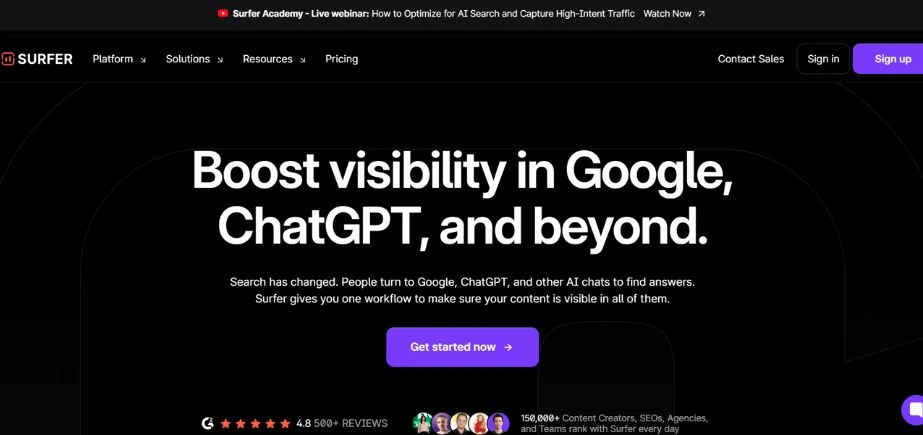
Surfer is the most popular AI content Optimisation tool on this list. Enter a target keyword, and it crawls the top-ranking pages and then gives you a live content score that updates as you write. A suggested term adds points to the score; straying from the topic subtracts points. Without an SEO expert reviewing each draft, writers may self-optimize. It benefits competitive keywords and speeds up editing by giving you a topic coverage gap analysis that shows you the subtopics competitors cover that your draft doesn’t.
Key features:
a live content score, NLP keyword guidance, topic gap analysis, SERP Analyser, Content Audit and Google Docs and WordPress integrations.
Pricing:
Essential: $79/month; Scale: $175/month; Enterprise: $999/month
Best for:
Content teams and agencies looking for real-time guidance without needing every writer to understand SEO theory.
Limitation:
Its AI assistant (Surfy) drafts well enough, but technical or niche subjects need a lot of editing.
2. Clearscope
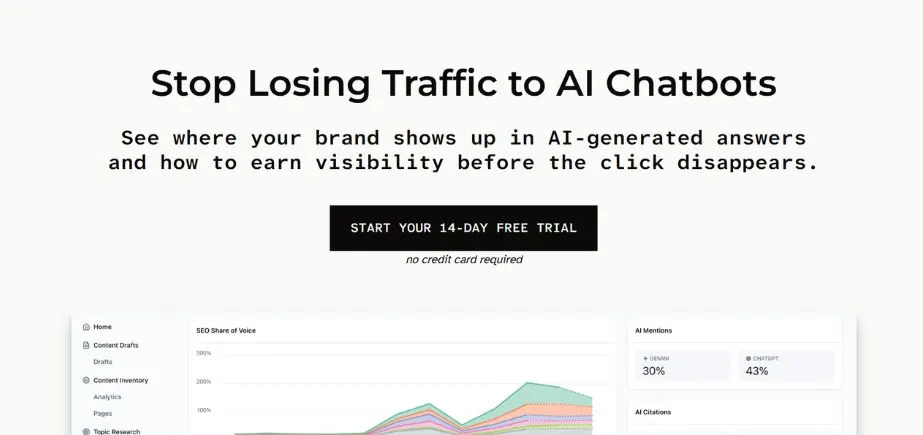
Clearscope helps teams publish articles that rank, and people actually want to read by balancing SEO performance with readability. Its reports pull semantic keywords, NLP entities and term frequency from ranking pages and present a clean, prioritised list, letting writers know which terms are most important and which are supplementary. Nothing feels too cluttered or overdone. It also watches out for content decay and lets you know when rankings begin to slip so you can refresh pages before you have to react to a drop in traffic.
Key features:
A+ to F content grading, readability analysis, decay monitoring, keyword discovery, Search Console connection, Google Docs and WordPress integrations.
Pricing:
Essentials from $129/month; Business $399/month; Enterprise custom
Best for:
Teams and agencies heavy on editorial with a need for quality control over multiple writers.
Limitation:
No AI writing feature. A different generator will be required for teams that need AI drafting.
3. Frase
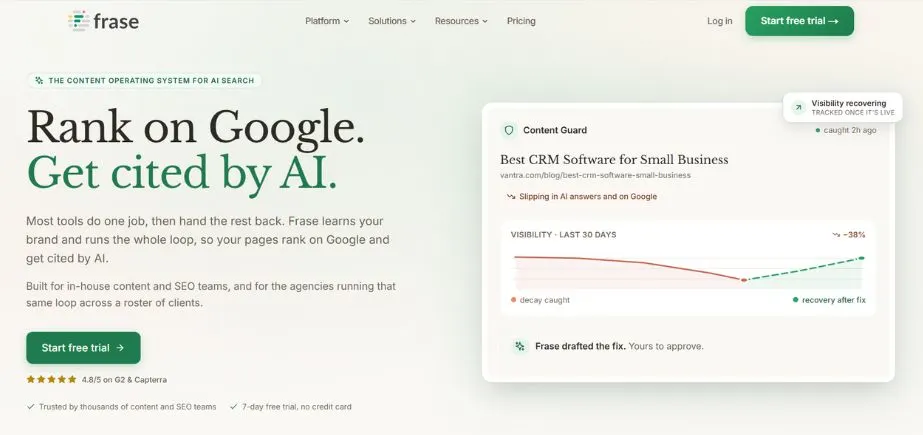
Frase is one of the most efficient AI content optimisation tools if building briefs is your bottleneck. In only a few minutes, it takes the headers from the top-ranking sites for a given topic, displays People Also Ask queries, and generates an organized outline. Work that used to take 45 minutes of manual SERP research can often be done in under ten, with a more consistent output from writers. It also includes a real-time scoring editor and AI writing assistance, addressing the whole workflow at a much lower price than enterprise competitors.
Key Features:
SERP research, AI outlines, question extraction, TF-IDF scoring, Short Templates.
Pricing:
Solo $38/month, Professional $98/month, Scale $195/month, Advanced $297/month.
Best for:
solo marketers, freelancers, and small teams who need a full research-to-draft workflow on a budget.
Limitation:
Compared to Surfer, the UI is less refined, and the Google Docs connectivity is not
4. MarketMuse
The most effective platform for websites with hundreds or thousands of pages is MarketMuse, which is also the most tactically advanced on our list. It analyzes the subject coverage of your whole domain, finds content gaps at the site level, and assists you in creating topic clusters to generate semantic authority rather than optimizing individual articles. You can stop speculating about what to publish next and make choices based on topical authority data since it displays the connections between subjects so you know what pages to develop and what current information to update or condense.
Key features:
Topic Navigator, SERP X-Ray of top 20 results, entity-mapped briefs, site-wide content inventory and cannibalization detection.
Pricing:
Free plan offered; paid plans start around $99 per month, and custom enterprise pricing is available.
Best for:
Enterprise SEO teams and agencies where site-wide strategy is more important than speed for individual articles.
Limitation:
steepest learning curve here; expect 3-4 weeks before the team is confident.
5. Semrush Writing Assistant
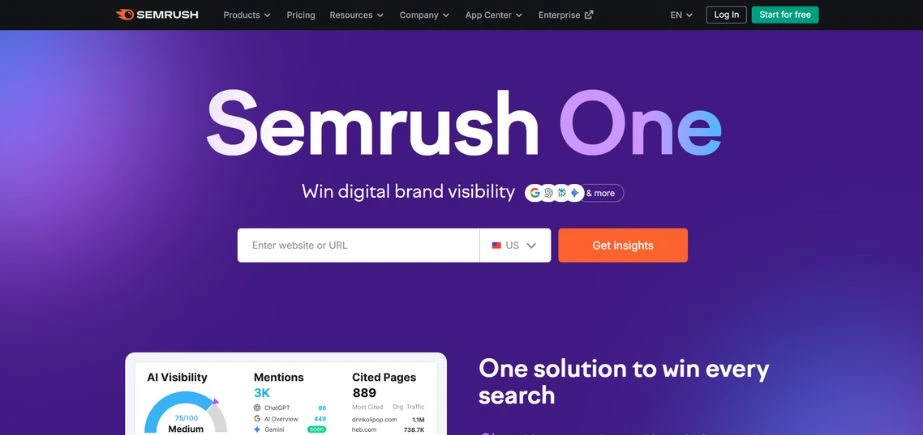
Semrush Writing Assistant is not the most comprehensive optimiser out there, but it is worth it for picking up on technical on-page issues like missing alt text, oversized title tags and thin content, as well as assessing content quality. Most other tools only look at keywords and topic coverage. This one assesses content for SEO, readability, tone of voice, and originality. It’s especially useful and practical for agencies working with freelancers or AI-assisted workflows, as it can catch duplicate or near-duplicate content before anything goes out.
Key features:
multi-dimensional scoring, flagging of technical issues, readability, tone detection, originality checker, integration of Semrush keyword data.
Pricing:
Includes Semrush Guru ($249.95/month) and Business plans.
Best For:
Teams that already use Semrush and want to optimise without another subscription.
Limitation:
It doesn’t give you as many keyword suggestions as Surfer or MarketMuse.
6. NeuronWriter
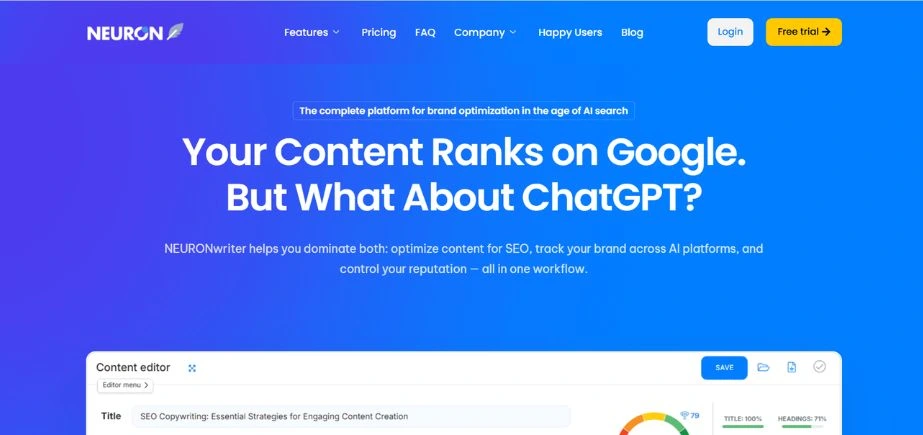
NeuronWriter is one of the most compelling options for teams on a budget that still need real semantic depth. It uses NLP models and SERP analysis to find out which terms, entities, and concepts are being dominated by top-ranking pages and then guides you on how to naturally include them while writing. What’s more, this software is unique because it provides users with an automatic link suggestion feature, while working smoothly with WordPress and Google Search Console. The depth it gives for the money is genuinely and consistently impressive.
Main features:
Semantic term extraction, real-time scoring, internal link suggestions, templates, AI writing assistance.
Pricing:
Bronze from $23/month; higher tiers add queries, AI credits and seats.
Best for:
Budget-conscious SEOs and bloggers looking for strong semantic depth.
Limitation:
Often requires heavy human editing for grammar and polish.
7. Scalenut

Scalenut describes itself as the “one-tab solution for content planning and production” and offers keyword research, topic clustering, SERP analysis, first-draft generation and on-page optimisation all on the same platform. The standout feature is Cruise Mode, which takes you on a guided workflow from target keyword to publishable draft. The output is kept in line with search intent by NLP keyword briefs, content rating, and internal linking recommendations. It provides coverage at a feasible price for small teams that can’t justify five different tools to spread the budget around.
Main features:
Cruise Mode, Topic Clusters, SERP Analyser, NLP brief builder, WordPress and Semrush integrations.
Pricing:
From $17/month (billed annually), up to roughly $89/month.
Best for:
Small marketing teams and solo creators looking for an affordable platform.
Limitation:
Large projects feel slow, and the writing often feels generic.
8. Outranking
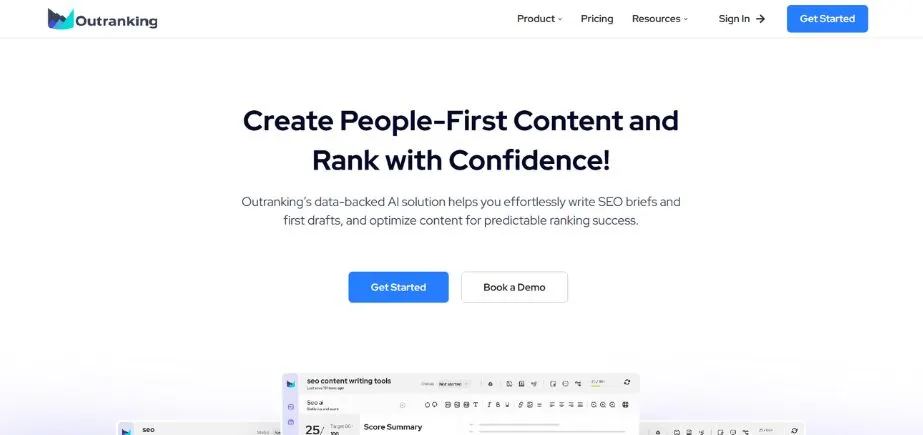
Outranking is for SEO-focused creators who want a structured, guided path from keyword research to a fully optimised page. Its unique feature is a step-by-step checklist for every article, so no optimisation action ever gets missed. That checklist takes into account SERP analysis, keyword recommendations and AI draft creation, so briefing, writing and optimisation all happen in a logical order, rather than randomly. It’s particularly beneficial for authors who are unfamiliar with SEO or for anybody seeking a repeatable, audit-proof procedure.
Key features:
SERP based briefs, per-article checklist, AI drafts, keyword suggestions, score tracking.
Pricing:
Starter is ~$19/month and ~$139/month.
Best for:
SEO writers and solo marketers who like guided workflows.
Limitation:
Interfaces are more cluttered than competitors; AI-generated facts need to be checked.
9. Dashword
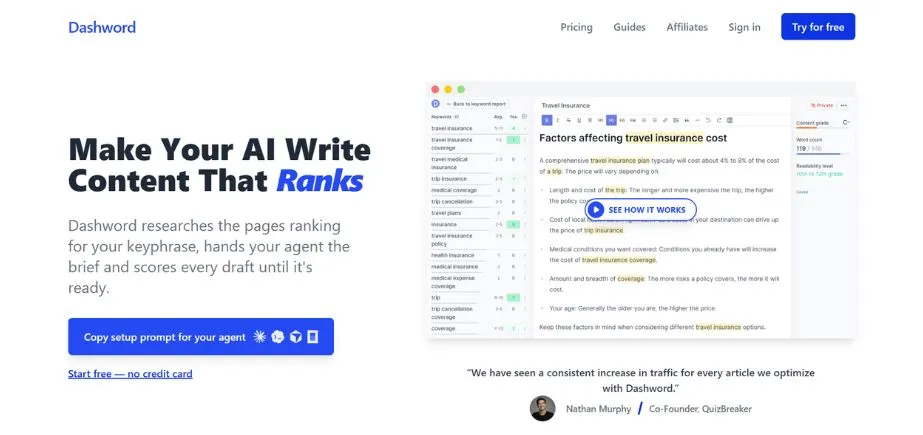
Dashword combines the speed of brief creation with visibility into content performance. It analyses top-ranking pages, pulls competitor headings, generates SERP-based outlines, and has a live-scoring editor — all in an interface that teams pick up fast. The Google Analytics connection is what sets it apart in the pricing range; when the articles are published, it monitors their performance over time and displays which Optimisation strategies are driving traffic and which are only inflating scores. Its short templates and manual outline control save content managers hours every week.
Key Features:
Fast builder with manual heading selection, live scoring, AI outlines, GA4 tracking, short templates.
Pricing:
Startup starts at $99/month and Business at $349/month.
Best For:
Agencies and content managers producing a high volume of content with freelance writers.
Limitation:
Keyword suggestions are more shallow; combine with a deeper tool to get competitive terms.
10. PageOptimizer Pro
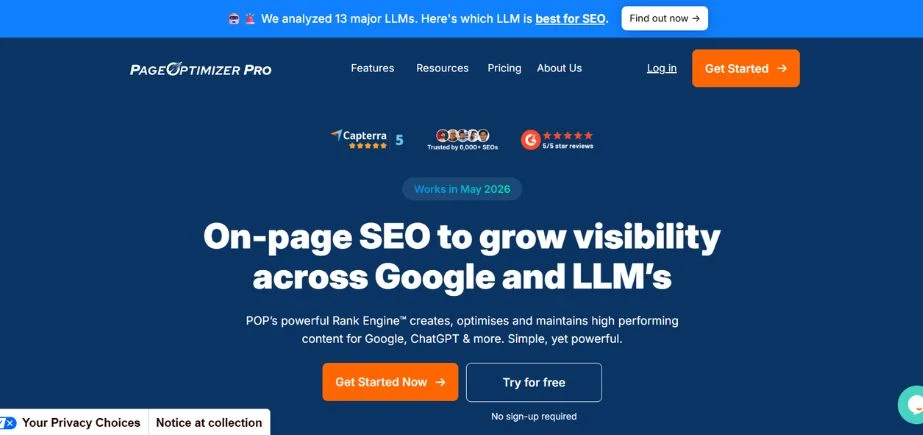
PageOptimizer Pro (POP) holds a special place. While many platforms make SEO easy for non-specialist authors, POP gives the professional writer the fine-grained control over the technical on-page features that others abstract away. It reveals TF-IDF scoring, LSI keyword extraction, NLP entity frequencies, E-E-A-T auditing and competitor benchmarking, with specific, actionable recommendations for each. If you’re going after ultra-competitive keywords where every variable matters, that extra depth is a real competitive advantage. Its E-E-A-T analysis is particularly useful for YMYL material in the legal, health, and financial sectors, to mention a few.
Key features:
TF-IDF per on-page element, LSI/NLP extraction, element-level optimisation, E-E-A-T auditing, SEO Competitive Index, batch analysis.
Pricing:
Unlimited from $56/month, Teams $108/month and White Glove $275/month.
Best for:
SEO specialists battling difficult keywords.
Limitation:
Not for non-technical users; writers without an SEO background will find it difficult.
11. GrowthBar
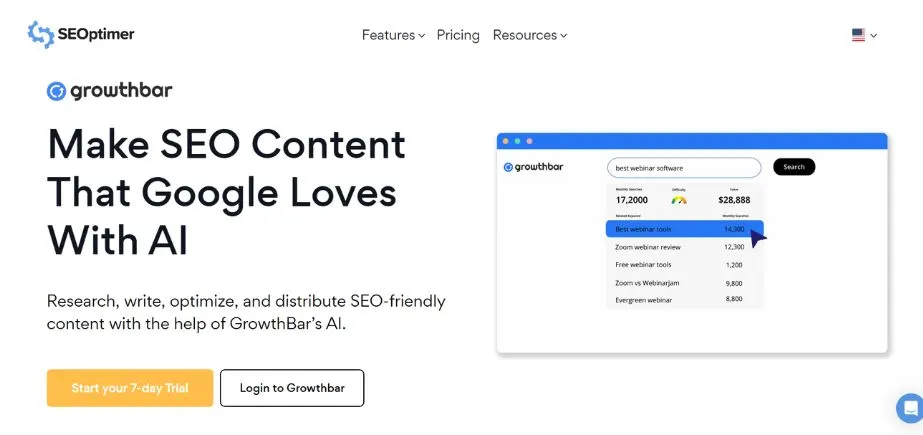
One of the most accessible price points, GrowthBar has a lot of capabilities built in. $29 per month gets you keyword research, competitive SERP analysis, AI content outlines, and AI-powered writing. The true distinction here is the Chrome extension, which makes competitive research easy by superimposing SEO data (domain authority, keyword difficulty, backlink counts, traffic projections) on top of the Google results as you surf. Hard to beat for bloggers and small businesses seeking capability without the premium pricing.
Key features:
Includes outline and first draft, keyword research with volume and cost-per-click, competitor analysis, and in-SERP overlay.
Pricing:
Standard $29/month, Pro $79/month, Agency $129/month
Best for:
Budget-conscious solo bloggers, freelancers and small teams that want the core features.
Limitation:
less semantic-intensive than MarketMuse, Surfer, or Clearscope.
12. Yoast SEO
Yoast is the most installed WordPress SEO plugin worldwide, with more than five million active installations. It’s not a full SERP-analysis engine like Surfer or Clearscope, but it does ensure every page you publish has its technical foundations in place. Its traffic light system lets you know if your focus keyword is in the title, URL, meta description, opening paragraph, and headings. Readability analysis highlights long sentences, passive voice, and missing transition words. The free version is useful for local and low-competition keywords.
Key features:
focus keyword checks, readability scoring, snippet previews, automatic sitemaps and schema, internal linking suggestions (Premium).
Pricing:
Core plugin is free; Premium begins at $118.80/year per site.
Best for:
WordPress bloggers and small businesses targeting low competition keywords.
Limitation:
Competitive keywords still need a dedicated tool upstream; this is not a semantic optimisation engine
How to Choose the Right AI Content Optimisation Tool
Match your bottleneck to the tool. Ask about the slowest part of your workflow:
- Writing Quality & Real-Time Keyword Coverage → Surfer SEO or Clearscope
- Quickly create briefs → Frase or Dashword
- MarketMuse: What to create or update first
- Technical on-page issues slipping through => Semrush Writing Assistant / PageOptimizer Pro
- Allocate budget to NeuronWriter, GrowthBar, or Scalenut
- WordPress basics → Yoast SEO plugin
Consider the SEO knowledge of your team. Surfer and Clearscope are intended for authors without any experience with SEO. MarketMuse and PageOptimizer Pro presume you are an expert.
Evaluate scale and size. Almost any instrument will work at two articles each month. Seat limitations and connections (such as Google Docs, WordPress, and CMS connectors) are important considerations when setting a weekly cap of thirty.
After posting, don’t forget to follow up. Refreshing high-potential pages rather than beginning from scratch is made easier by MarketMuse’s inventory auditing, Dashword’s GA4 integration, and Clearscope’s decay monitoring.
What to Expect from Any Content Optimisation Software
Whatever shortlist you come up with, these are the features that really make a difference:
Depth of SERP analysis. Does the tool look at the top 10 or top 20 results? Does it extract entities and semantic clusters in addition to keyword frequencies? A more precise direction is provided by a more thorough investigation.
Content scoring technique. Scores vary widely by platform. Choose tools that reward topical depth and semantic relevance instead of keyword density. A tool that makes you over-optimise is a liability, not an asset.
NLP & Semantic Intelligence. The best tools not only assist in identifying the primary keywords but also pertinent entities, semantic variants, and context keywords that provide complete coverage for the Google algorithm.
Instant feedback. Live scoring as you write is nowhere near as inefficient as static briefs. The shorter the feedback loop, the less time writers spend back and forth between the tool and the draft.
Workflow Integrations: The copy-paste friction that destroys writer flow is eliminated with Google Docs, WordPress, and CMS connections. Before you commit, always check what integrations a platform offers.
Post-publication surveillance. Traffic doesn’t magically appear the minute you publish, and it doesn’t last forever. Performance monitoring tools over time help you identify decay and refresh opportunities before ranking tanks.
Total Cost of Ownership: Ignore the headline price. When a team takes a $23 plan daily, seat caps, query caps, and AI credit allocations can push you way beyond what you thought. Make sure you know what the tier you actually need covers before you commit.
Common Mistakes When Using AI Content Optimisation Tools
Even the best platform can be a disaster if it is not used correctly. Beware of these pitfalls:
Trying to be perfect. Rankings are not assured by a score of 100. You can’t stuff every suggested term into your draft, or you get stilted prose that readers abandon and Google increasingly discounts. Write to get a competitive score, but also write like a normal person. Take suggestions as recommendations, not orders.
Ignoring the search intent. Although ranking sites may be explained by tools, they are not always able to explain why people are seeking. Before writing, check whether the top results are guides, listicles, product pages or comparisons and imitate that format.
Skipping human knowledge. Optimisation tools measure coverage, not insights. The 2026 winning articles combine strong topical coverage with original experience, data and opinion that no competitor page has. That is how you get E-E-A-T.
Considering Optimisation as a one-off task. SERPs are changing. A page that did well last year might not have the terms, entities or questions that new competitors now answer. Add refresh cadence to your editorial calendar — The [industry]
Buying too many tools too early. A single blogger rarely needs an enterprise topic-modelling platform. Begin with the least complex tool that addresses your most pressing bottleneck and upgrade as your volume or ambitions increase.
Conclusion
Real-time writing guidance, integrated with Google Docs? Surfer SEO.
Do you have an editorial team that needs quality control, standardised briefs? Clearscope.
Tight budget but need the whole workflow? Frase or NeuronWriter (Read:
Big site? Need a portfolio-level strategy? Market Muse.
Are you already in the Semrush ecosystem? Semrush’s Writing Assistant.
Beginning with WordPress? Yoast SEO, and it’s free.
Whatever you choose, the most essential thing is to use it on a daily basis. Optimised content is one of the highest-ROI activities in content marketing. The compounding effect of well-optimised content, article after article, is … Test any tool on two or three articles before rolling it out across your program, upgrade when you outgrow it, and publish content built to rank from day one.
Explore More: SEO for Construction Companies
FAQs on AI Content Optimisation
What is the best AI content Optimisation tool for beginners?
Surfer SEO or Yoast SEO. Surfer’s real-time, colour-coded feedback doesn’t require an SEO background, while Yoast provides WordPress users with a free, low-friction checklist before publishing.
Can AI content optimisation tools guarantee better rankings?
Not at all. Google considers hundreds of variables, including page experience, backlinks, authority, and engagement. These tools boost your chances because they ensure that your content will be aligned with ranking content, not because they reduce any uncertainty.
How do AI content optimisation tools help SEO?
They assist with keyword selection, competitor content gap analysis, topic completeness scoring, technical SEO, and post-publishing performance monitoring.
Are AI content optimisation tools good for agencies?
Yes. Surfer, Clearscope, MarketMuse and Frase all offer agency plans with team seats, client workspaces, and white-label reporting. Scalenut and Outranking provide workflow automation for less. Focus on integrations, seat limits and handling multiple clients.
What distinguishes AI content optimisation tools from AI copywriting assistants?
Applications such as ChatGPT, Jasper, or Copy.ai create drafts based on your prompt. The material that is now at the top of the search results will be analyzed and optimized using an Optimisation tool. Frase, Surfer, and Scalenut. Make use of Optimisation tools to guarantee a competitive result and writing tools to write more swiftly.
Do I need more than one AI content optimisation tool?
No, not often. One platform that incorporates research, briefings, and grading is ideal for the majority of small teams. Larger operations might use a combination of a strategy tool like MarketMuse and a writer-friendly editor like Surfer or Clearscope, where strategists plan topics at the site level, and writers optimise individual drafts. IYoast is a cheap last check for any setup if you use WordPress. Just ensure that whatever you blend together doesn’t have tools providing conflicting guidance that confuses your writers.
Will AI content optimisation tools get me on AI Overviews?
Indirectly. They do not ensure you will get cited, but well-covered topics, proper headings, answering frequently asked questions directly, and comprehensive coverage of the entities are the things which are generally used for writing AI-generated summaries. People Also Ask questions and topic gaps tools can assist in building pages which answer questions properly.
How often should I re-optimise current content?
Review your best-performing pages every 3-6 months and check your competitive keywords every quarter to find new competitors, changes in search intent, or incomplete topic coverage.