Search is not just one channel anymore. As AI-powered platforms revolutionise the way people find content, marketers have a burning question: is AI SEO vs traditional SEO a true fork in the road, or are they two lanes on one highway? Before they can set strategy, every serious digital marketer must have a clear answer to the AI SEO vs traditional SEO question in 2026. This guide explores every major difference, compares strategies side by side, and shows you exactly how to crush both.
What Is Traditional SEO?
Traditional SEO is the practice of making your website more visible on search engine results pages (SERPs), mostly Google and Bing. Old-school SEO techniques have evolved over 20 years to include on-page optimisation, link building, technical improvements, and human-driven SEO expertise in keyword targeting.
Traditional SEO strategies are focused on getting your content found by crawlers like Googlebot who index your pages and rank them based on hundreds of signals like relevance, authority, page experience and E-E-A-T (Experience, Expertise, Authoritativeness, Trustworthiness).
Organic search optimization in the traditional sense still drives a lot of traffic. Every year, Google alone processes more than five trillion searches, or about 13.7 billion queries a day. To ignore this channel would be a colossal mistake for any business.
What is AI in SEO?
AI SEO, or Generative Engine Optimisation (GEO) or Answer Engine Optimisation (AEO), is the process of optimising content to be included in AI-generated answers from tools like Perplexity, Google AI Overviews, Bing Copilot, and Claude.
When we’re talking about AI SEO vs traditional SEO, we’re really talking about two ecosystems. In AI-powered search, LLMs collect content from a variety of sources and provide a direct answer, often without referring the user to a website at all. This has thus shifted the goal of AI in search engine optimisation: Instead of ranking #1 on a SERP, you want your brand referenced in the AI’s answer.
How does AI-powered SEO compare? AI-powered SEO is based on the same principles as traditional search — quality content, authority, technical health — but adds new elements around how AI crawlers reach and digest your pages.
AI SEO vs Traditional SEO: What’s the Difference
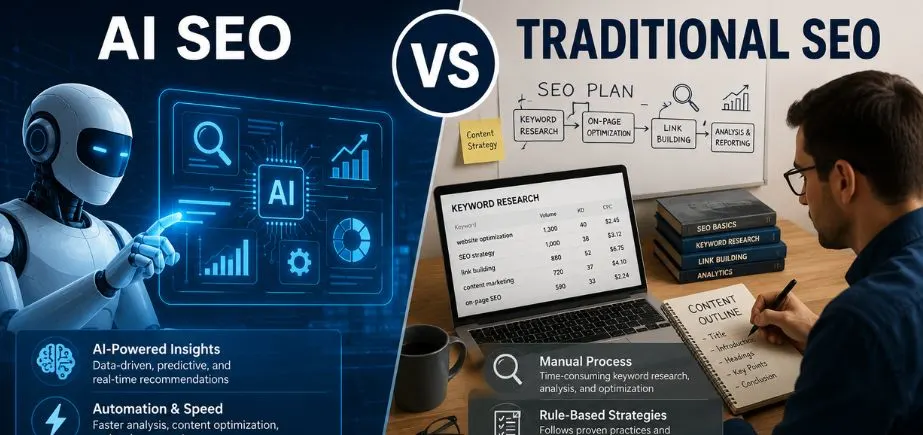
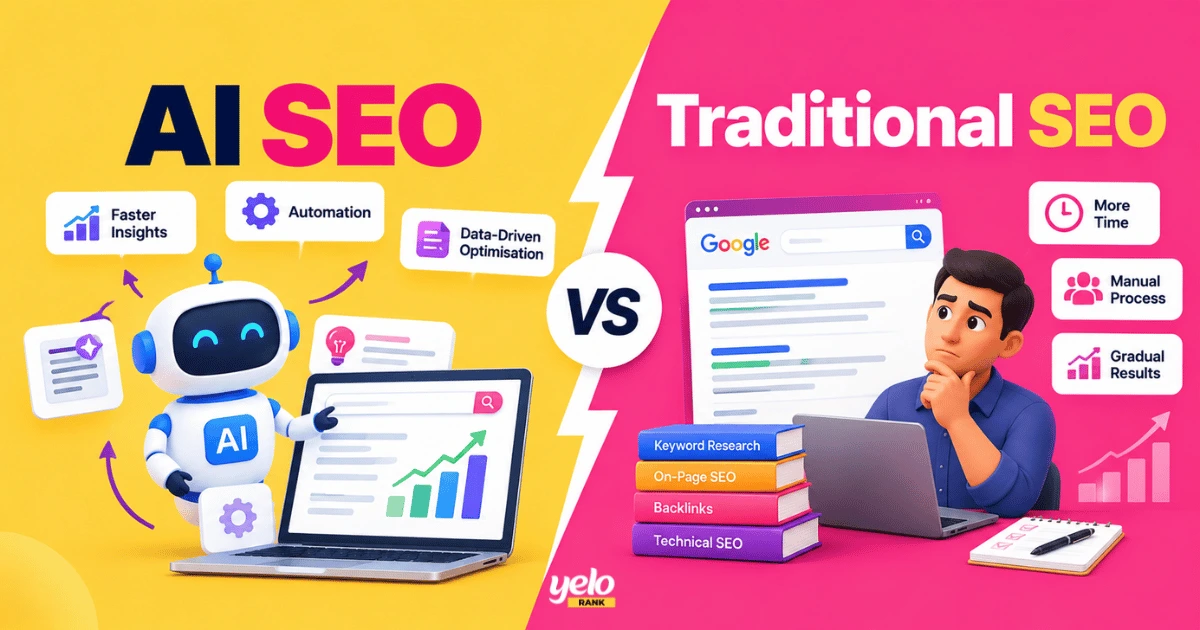
Before you spend your budget or time, it’s imperative that you understand AI SEO vs traditional SEO on a structural level. The two approaches differ in every major aspect, as follows:
| Size | Old School SEO | AI-SEO |
| Main Objective | SERP position (blue links) | Answers generated by AI appear in |
| Target Platform | Google, Bing, Yahoo | ChatGPT, Perplexity, AI Overviews, and Gemini |
| Keyword Targeting | Short to mid-tail keywords (avg. 4 words) | Conversational prompt (at least 8 words) |
| Content Style | Crawler-friendly, keyword-optimized | Easy to extract direct, self-contained |
| Signal Links | Backlinks (dofollow) are the main authority signals | Unlinked mentions of brands also count |
| Measurement | Rankings, organic traffic, CTR, conversions | Sentiment, share of voice, AI mentions |
| SEO Automation Workflow | Moderate (rank trackers, audit tools) | High (track prompts, AI content optimisation) |
| Element of the Human | Tool-assisted human-led SEO | AI SEO with a human assist |
The difference between AI SEO and traditional SEO is not that one will replace the other. It’s about broadening your footprint into a much bigger search ecosystem. To frame AI SEO vs traditional SEO as a competition is to miss the bigger opportunity entirely.
Keyword Research Then and Now
Classic SEO: Keyword Targeting
The traditional way to create SEO content starts with using AI-powered keyword research tools or, in the pre-AI era, manual research with the help of Google Keyword Planner, Ahrefs, or Semrush. You discover search terms that your audience is entering into Google. You determine the monthly search volume and keyword difficulty. You develop content around those terms.
For example, a typical keyword strategy may consist of a primary keyword (for example, “AI SEO tools”) and a cluster of secondary keywords (for instance, “best SEO automation software” or “AI content optimisation platforms”). The average keyword length of top-ranking pages is around four words. Equally important is to identify which keywords are already pulling backlinks to your competitors. The best business opportunity backlink analysis tools can reveal untapped link gaps you can exploit before rivals do.
AI SEO: Coverage of Topics and Prompt Mapping
In AI SEO versus traditional SEO, keyword research becomes prompt mapping. AI tools answer natural-language questions that are much longer and more conversational. For instance, instead of asking “AI SEO tools, ” a user may ask ChatGPT: “What are the best AI-powered SEO tools for a small e-commerce store on a budget in 2026? ”
AI-Powered Keyword Research for LLM Optimisation Means:
- Whole topic clusters, not individual keywords
- The conversational purpose of prompts
- Producing content that provides comprehensive answers to questions in separate sections
- Featured-snippet style answers that AI can pull out easily
This is the reason for the two-pronged approach to modern SEO techniques – optimisation for the four-word query and the eight-word prompt.
Content Creation: Human-Led vs AI-Assisted
Human-Led SEO Content
Human SEO content has always been about depth, expertise and originality. SEO content creation usually goes like this: research the keyword, outline the article, write with the target phrase in the title and headers, add internal links, optimise meta tags. Quality is important, but so are placement and density of keywords.
Artificial Intelligence Content Optimisation
AI content optimisation reverses some of these priorities. The key focus of AI-driven content in the AI SEO vs. traditional SEO debate is:
1. Direct Answers First Each H2 or H3 section needs to begin with a clear, standalone answer to the question in the header. AI systems take chunks of content and stitch them together — if your section requires context from the previous paragraph, it won’t be selected.
2. Standalone sections Each section needs to be clear enough to stand alone and provide necessary information to your reader. Avoid expressions like “as stated above” or “in addition to what was stated above.” This is proper SEO technique 2026 and an absolute must if you’re working with AI.
3. Authority Authority is one of those things that generative AI in SEO appreciates a lot.
Citation of authors’ work, E-E-A-T metrics, original author’s biography, statistic taken from a reliable source, personal experience – all of these signal authority.
4. Structure and schema Schema markup was used before in conventional SEO but now, in the age of AI, it becomes extremely useful as it helps LLM understand the connection between entities on your page.
SEO AI writing process includes a combination of various tools and approaches to create quality SEO copy. Among them are Jasper, Surfer SEO or MarketMuse.
The best AI vs human SEO results come from collaboration, not replacement.
Technical SEO: Shared Foundation, New Demands
Technical SEO is still the backbone of both approaches. In the AI SEO vs traditional SEO comparison, most of the technical best practices overlap:
- Great Core Web Vitals and fast page load times
- Mobile-friendly and responsive design
- HTTPS Secure Implementation
- Clean site architecture and internal links
- Correct robots.txt configuration
- XML sitemap
- Structured data / schema.org markup
But SEO powered by AI introduces new technical requirements:
AI Crawler Access
All of the aforementioned AI tools such as ChatGPT (on Bing), Perplexity, Anthropic’s Claude bot and Google Gemini have their own crawlers. If your robots.txt blocks these bots, you are invisible to AI search. Make sure you are explicitly allowing GPTBot, PerplexityBot, ClaudeBot and Google-Extended.
Rendering Javascript
Vercel’s research shows most major AI crawlers do not render JavaScript. If your content is loaded dynamically with JS frameworks, AI tools will only see a blank page. Automation of SEO processes in preparation for AI includes audits for JavaScript content, as well as SSR if necessary.
HTML Data Structure
Your HTML code will be interpreted by LLMs to determine useful content. Clean HTML code with appropriate heading order (from H1 down to H3) will make content extraction easier for AI.
Brand Mentions vs Link Building
This is one of the most glaring differences in the AI SEO vs traditional SEO debate.
Old-school Link Building
Organic search optimization has always been about backlinks. Still, one of the most powerful traditional SEO signals is a high-authority dofollow backlink from a relevant domain. Half the battle is knowing where the link opportunities are, and where competitors are gaining ground. Whether you are using Semrush, Ahrefs or one of the best business opportunity backlink analysis tools out there, regular backlink auditing helps you find link gaps, kill toxic links and efficiently prioritise outreach targets.
AI SEO: The Growth of Unlinked Brand Mentions
In AI SEO vs traditional SEO, AI models do not use link graphs alone to determine authority. They also like:
- Unlinked brand mentions from news articles, reviews, forums & directories
- Brand consistency – same name and description of the entity in many sources
- Sentiment – positive associations and third-party authority
- Digital PR – Getting featured on industry publications (even with a nofollow link)
So your AI-powered SEO link-building strategy needs to scale to include digital PR campaigns, thought leadership placements, and reputation management — not just traditional backlink outreach.
AI SEO Tools You Must Have in 2026
AI SEO tools have matured quickly. Here’s a breakdown of the essential stack for AI SEO vs traditional SEO across both worlds:
For classic SEO
- Semrush/Ahrefs – keyword research, rank tracking, backlink analysis
- Google Search Console – Organic clicks and index status, Core Web Vitals
- Screaming Frog – Crawl audits for technical
- Surfer SEO – Content Optimisation Score
For AI-SEO
- Semrush AI Visibility Toolkit – Monitor brand mentions, citations, and share of voice across ChatGPT, Perplexity, and AI Overviews
- Deep – Tracks LLM responses by brand mentions
- Goodie AI – AI citations tracked
- Otterly.ai – AI SERP monitoring & prompt tracking
For Both (SEO Automation)
Tools like Clearscope and MarketMuse offer SEO workflow automation, combining AI content optimisation with legacy keyword targeting in a single interface.
Performance Comparison: The Metrics That Matter
How do you know if your combined AI SEO vs traditional SEO strategy is effective? Track the metrics in both channels.
Traditional SEO Metrics
- Organic traffic (Google Analytics 4)
- Keyword rankings – track the position of your target terms
- Click-through rate (CTR) – from Google Search Console
- Organic traffic conversion rate
- Domain authority / referring domains – Using the best backlink analysis tools to benchmark your link profile against competitors
Artificial Intelligence SEO Metrics
- AI Mentions – How Frequently Your Brand Appears in AI Responses
- AI citation rate – How often you are cited as a source
- Share of voice – your brand’s presence vs competitors on AI platforms
- Sentiment score – How AI describes your brand (positive, neutral, negative)
- Prompt coverage – how many relevant prompts your brand appears in
Why does this SEO comparison of performance matter? Because LLMs are pulling traffic fast. Industry data indicates that LLM-driven traffic will exceed traditional organic search traffic by 2028. Measuring both sides of the equation is now a baseline SEO best practices 2026 requirement.
Do You Need Two?
Yes. Absolutely yes.
AI SEO and traditional SEO are not mutually exclusive. Traditional search engines still handle trillions of queries every year. Chasing AI citations alone means leaving enormous traffic volume on the table by abandoning traditional SEO.
Meanwhile, ignoring AI SEO means invisibility for a fast-growing group of searchers. ChatGPT now has more than 700 million weekly active users. Perplexity, Google AI Mode, and Bing Copilot are all gaining daily active users at pace.
The future of SEO will belong to brands that view AI SEO and traditional SEO as the same challenge. Owning the whole modern search funnel is a page that ranks #1 on Google AND is being cited in ChatGPT responses.
Niche Industry Consideration: The stakes are even higher in sectors such as financial technology. Fintech brands face increased regulatory scrutiny, more E-E-A-T requirements, and a more competitive environment where AI-generated recommendations can make or break product discovery. If you are in this space, working with specialists is important – the top GEO agencies for fintech firms get the compliance restrictions and citation-building strategies required to achieve sustained AI visibility in an industry where trust signals are critical.
SEO Best Practices 2026: The One Strategy
Here’s how to build a winning strategy for AI SEO vs Traditional SEO at the same time:
1. Build Topical Authority, Not Pages
Make use of pillar pages and content clusters to cover topics thoroughly. This complies with Google’s helpful content standards as well as LLM training data preferences.
2. Write for Extraction
Each section of each article should begin with a direct answer. Consider it like writing for featured snippets, because AI responses are basically the next evolution of that.
3. Improve Your E-E-A-T
Author bios, cited sources, original research, and real-world expertise signals help you rank in organic search optimisation AND get cited by AI tools as a trustworthy source. E-E-A-T requirements are actually even more rigorous for regulated industries like finance and fintech; consulting the top GEO agencies for fintech companies can help you to develop the kind of credibility profile that earns AI citations in compliance-sensitive verticals.
4. Build Your Link & Mentions Profile
Both feed into your authority. Dofollow backlinks for classic SEO strategies AND unlinked mentions through PR for AI-powered SEO.
5. Audit access to AI Crawler
Check your robots.txt and make sure AI crawlers are able to crawl your content. This is low-hanging fruit that many sites still miss.
6. Follow Both Ecosystems
Use tools that provide visibility into both traditional rankings and AI citations. If you’re looking at one channel in a silo, you’re not getting the full picture of your search ranking strategies.
7. Use SEO Automation – Carefully
SEO automation tools can speed up keyword research, content briefs and audit workflows. But human oversight is still needed for strategic judgment, factual accuracy and brand voice. AI vs human SEO results are better realised through augmentation and not abdication.
8. Invest your money in Digital PR
Brand mentions, even without links, now have real SEO and AI SEO weight. The AI content marketing strategy needs to include media coverage, expert roundups and industry directory listings.
Frequently Asked Questions
Is Old School SEO Dead?
Not at all. AI SEO vs traditional SEO is not a battle of life and death. Google handles billions of searches a day and traditional search engines still account for the majority of web traffic. Traditional SEO is still very important. What has changed is that they now have to be supplemented by AI optimisation.
What is the difference between AI SEO and traditional SEO?
The biggest difference between AI SEO and traditional SEO is the output you’re optimising for. Traditional SEO is about getting you a position on a SERP. AI SEO is targeting inclusion in an AI-generated answer that may not even have a clickable link.
What if I already have a traditional SEO strategy? How do I get started with AI SEO?
Audit your robots.txt to allow AI crawlers, restructure your key content pages to open each section with direct answers, and start tracking your brand’s presence in AI tools using platforms like Semrush’s AI Visibility Toolkit. Then add a layer of digital PR to generate unlinked mentions alongside your existing link-building programme.
Which AI SEO tools are most important in 2026?
Top AI SEO tools in 2026 are: Semrush’s AI Visibility Toolkit to track AI citations and share of voice, Surfer SEO for AI content optimisation and Profound or Otterly.ai to track at the prompt level. Combine these with your existing traditional SEO stack for complete coverage.
Is AI content marketing replacing traditional SEO content creation?
No. AI content marketing and SEO content creation go hand in hand. AI tools accelerate the research and writing process, but you need human expertise to ensure accuracy, brand alignment, and the kind of real insight that both Google’s algorithms and LLMs are increasingly trained to reward.
What is the future of SEO?
The future of SEO is multi-modal and multi-platform. Search will increasingly be done across traditional engines, AI chatbots, voice assistants and embedded AI capabilities within apps and browsers. Brands that invest in both AI-based and traditional SEO strategies today will be best positioned to capture the full range of search intent tomorrow.
Concluding Thoughts
Ultimately, the discussion of AI SEO vs traditional SEO is a false dichotomy. You have to have both. Both are changing. And they both reward the same core thing: content that is useful, authoritative, well-structured and answers real questions.
What’s changed is where that content has to live and the format you have to get it into to get there. Think of AI SEO as a single discipline – not two competing priorities – versus traditional SEO, and you’ll create a search presence that’s resilient, scalable and future-proof.
The evolution of AI SEO vs traditional SEO will continue as search platforms evolve. Stay tuned by following both ecosystems, investing in great content, and evolving your SEO workflow automation stack as new tools enter the market. The brands that will own search in the coming years are those who see AI SEO vs traditional SEO as one holistic, integrated challenge.